
On Monday 16th December, Senior Course 123 arrived in Belgrade, the capital of Serbia and the third largest city in South-eastern Europe after Istanbul and Athens.
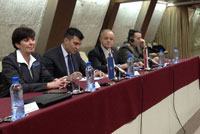
Next day, led by NDC Dean Dr Daria Daniels-Škodnik, the group attended a full programme of briefings at the Topčider Guard House, in the magnificent Topčider Park. They were welcomed by Mr Zoran Ɖorᴆević, the Secretary of State in the Ministry of Defence.
A first briefing, focusing on “The Security Policy of the Republic of Serbia”, was delivered by Mr Miomir Udovički, Assistant Minister of Foreign Affairs for Security Policy. He explained the various reforms Serbia has instituted with a view to European Union membership, spanning a number of sectors: defence and security, science and the environment, public information, and the commitment to fighting corrupt practices. Mr Udovički also spoke about Serbia’s efforts in terms of partnership programmes with neighbouring countries and with representatives of minority communities. He gave a detailed update on projects and agreements with Kosovo, a subject which prompted considerable interest from the audience.
Mr Miroslav Jovanović, Assistant Minister for Defence Policy, then spoke about “Defence Policy and Ministry of Defence (MOD) priorities in International Cooperation”. Following a description of the Serbian MOD, he explained the extent of Serbia’s commitments with NATO, the EU and other international organizations. These engagements are paramount for the development of Serbian defence policy and for the guarantee of a secure, peaceful environment, both at domestic level and within the Balkans. Serbia is also developing regional initiatives to cooperate with neighbouring countries, such as: the South East Europe Defence Ministerial (SEDM), the Southern European Cooperation Process (SEECP), the Adriatic Charter (with observer status), the Southeastern and Eastern Europe Clearinghouse (SEEC), and the Regional Cooperation Council (RCC). Serbia also takes part in peacekeeping operations, such as EU NAVFOR ATLANTA (Somalia) and EUTM Somalia (based in Uganda); in addition, it has expressed willingness to participate in the EUTM operation in Mali. Another topic on which the speaker commented was Serbian involvement in EU cooperation initiatives (e.g. the agreements on cooperation with the European Defence Agency (EDA) and on exchange of classified information). He then spoke about Serbia’s educational capabilities and the institutions concerned (e.g., University of Defence, CBRN Training Centre, Technical Overhaul Institute, Peacekeeping Operation Centre of the Serbian Armed Forces General Staff). The University of Defence, the main educational institution in Serbia, was recently visited by a group from NATO’s Defence Educational Enhancement Programme (DEEP). Enhanced education and training are among the issues that will be covered by the Individual Partnership Action plan (IPAP) that NATO is currently developing with Serbia.
The next briefing was by MajGen Vojin Jondić, Head of Operations of the General Staff (J-3), who focused on “The Participation of Serbian Armed Forces in Multinational Operations and the Cooperation with KFOR”. There was then a final briefing entitled “The Highest Level of Education in the MOD and SAF”, by Col Slobodan Joksimović, Head of Advanced Studies in Security and Defence.
Topics covered in the ensuing discussion included the possibility of cooperation with the NDC. This subject was explored in greater detail in the course of a subsequent exchange of views between Dr Daniels-Škodnik and Mr Jovanović.
The visit to Belgrade was profitable for all Course Members, and stressed the key role that Serbia plays in promoting peace, stability and reconciliation throughout the Western Balkans.
For the last stage of this fascinating and instructive Field Study, SC 123 is currently en route to Podgorica.
NDC Public Affairs Office

 NATO Defense College
