
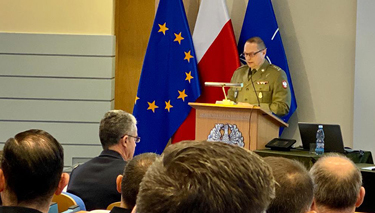
On 12 November Senior Course 135 was welcomed to Warsaw by the Vice-Rector for Military Affairs at the War Studies University, Col Prof. Dariusz Majchrzak.
The first briefing was given by the Chief Expert of the Department of International Security Policy at the Ministry of National Defence, Dr Tomasz Ekiert, who spoke about the Polish perspective on security in the European and transatlantic context. He mentioned a number of concerns, such as Russia’s military activities in the Baltic Sea region and Eastern Europe, hybrid warfare scenarios and the security situation in the MENA region. The speaker then outlined the ongoing development of Poland’s defence capabilities, in terms of budget, consistency of territorial defence forces, force numbers and modernization. After speaking about the NATO and US presence on the Eastern flank and NATO forces ready for deployment there, he discussed CFSP, NATO-EU cooperation and regional cooperation.
There was then a briefing on Polish foreign policy, by the Director of the Bureau of the Political Director in the Ministry of Foreign Affairs, Mr Maciej Stadejek. He mentioned three priorities: security, conditions conducive to further development, and authority building. With regard to NATO, Poland meets the 2% of GDP defence expenditure requirement. With regard to the EU, Poland supports enhancement of its role in security (PESCO, etc.) and sees the EU as a platform for development. Poland’s cooperation within the region (Three Seas Initiative, Berlin Process, Eastern Partnership) was also mentioned.
The Chief Expert of the J-5 Branch in the General Staff of the Polish Armed Forces, Col Jaroslaw Rybak, then spoke about the Polish Armed Forces’ goals in NATO and their modernization. Poland contributes to the three core tasks of NATO (collective defence, crisis management and cooperative security) by participating in national, multinational and NATO exercises, as well as NATO-led operations and missions; it also cooperates with NATO’s partners. The Polish Armed Forces’ priorities for development were briefly discussed.
The next briefing was by the Head of the International Security Programme of the Polish Institute of the International Affairs, Dr Marcin Terlokowski, who spoke about the international security situation from the Polish perspective. He mentioned two strategic documents on security: the 2024 National Security Strategy (2014; NSS) and the 2017 Concept of Defence of the Republic of Poland. The second part of the briefing was focussed on Russia.
After the final briefing on the Armed Forces’ priorities by the Deputy Chief of the Military Analysis Branch of the Armed Forces Supervision Department in the National Security Bureau, Col Robert Morchal, there was a concluding Q&A.
The visit ended with a reception hosted by Major General Jaroslaw Gromadzinski, an Ancien of Senior Course 117.
NDC Public Affairs Office
 NATO Defense College