Skip to content
July 21, 2026
  • Facebook
  • X
  • LinkedIn
  • Youtube
  • Instagram
  • Flickr
NATO Defense College

NATO Defense College

Unitatem Alentes

NDC_103x103
  • Home
  • Courses
  • Publications
  • Jobs
  • NDC Foundation
  • FAQs
  • Education mail
Primary Menu
  • Home
  • Organization
    • About Us
      • Mission
      • Who’s Who?
      • Structure
      • History
      • Vox Collegii Magazine
    • News
    • Resources & Services
      • Library
      • Facilities
      • Links
      • Vision Link
      • FAQS
    • Opportunities
      • Job Opportunities
      • Procurement
    • Contact & Information
      • Contacts, maps, visits
      • Follow us
      • Disclaimer
  • Education
    • General Information
      • On-site Courses
      • e-Learning
      • Academic Calendars
      • Study Projects
    • Long Courses
      • Senior Course
      • NATO Regional Cooperation course (NRCC)
    • Short Courses
      • Generals, Flag Officers & Ambassadors’ Course (GFOAC)
      • Generals, Flag Officers and Ambassadors’ Course for Partners, GFOAC-P (former SERC)
      • Modular Short Courses (MSCS)
      • Modular Short Course Partners Integrated (MSC-PI)
    • Partnerships
      • NDC Leicester Partnership
      • NDC LUISS Partnership
      • NDC Simon Fraser Partnership
    • Administration
      • Members’ Administration Section (MAS)
  • Research
    • About Research Division
    • Researchers
    • Publications
    • Opportunities
    • NATO NextGen Futures
  • Engagement
    • Conference of Commandants
    • International Week in Kyiv
    • Anciens’ Seminar
    • Other Engagement
  • Portals
    • Academic Portal
    • NDC Anciens’ Association
    • Academic Advisory Board
    • NRCC Academic Advisory Board
    • Conference of Commandants
  • Newsletter
    • Vox Collegii Newsletter
  • en_USEnglish
    • fr_FRFrançais
  • Home
  • News
  • Deterrence by detection: using surveillance to pre-empt opportunistic aggression
  • News

Deterrence by detection: using surveillance to pre-empt opportunistic aggression

Published: January 14, 2021 | Updated: January 15, 2026 3 minutes read

  • NDC Policy Brief 01-21: Deterrence by detection: using surveillance to pre-empt opportunistic aggression, by Thomas G. Mahnken and Grace B. Kim.*

“On NATO’s entire Eastern and South-Eastern flank, the Allies face a major, pressing and subtle challenge. Using sub-conventional grey zone tactics, Moscow has repeatedly tried, and at times succeeded, in expanding its influence, eroding international norms, undermining the rules-based international order, and shifting the balance of power in its favour. Preventing Russia from launching such opportunistic acts of aggression is particularly important because its armed forces are developing the ability to attack quickly – under the cover of increasingly capable defences – countries on their periphery in a clear effort to impose a fait accompli.1 NATO countries are at a particular disadvantage in this type of competition. Their force structures consist of expensive and technologically complex information-gathering platforms, such as satellites and manned aircraft, which due to their high costs are also scarce and employed with reluctance by states who generally hesitate to put them in harm’s way.

Additionally, the prohibitively high cost of these platforms deters some countries from investing in these types of capabilities. As debates within NATO about cash, capabilities and contributions continue to hold the stage, highlighting Allies’ needs for different types of capabilities – less expensive, more resilient, and relatively more disposable – is important.2 Equally critical is the need for Allies to develop new concepts of operations as well as new organizations to employ them effectively. The solution may not involve fielding exotic new capabilities so much as employing existing ones in innovative ways. It will also benefit greatly from approaches that allow Allies and partners to participate fully. If we do not adapt, we risk being surprised by potentially catastrophic events in a future conflict.”


Download the publication
to keep reading.


* (back) Thomas G. Mahnken is President and Chief Executive Officer of the Center for Strategic and Budgetary Assessments (CSBA), a Senior Research Professor at the Merrill Center for Strategic Studies at Johns Hopkins, and a Non-Resident Associate Fellow at the NATO Defense College.
Grace B. Kim is a Senior Analyst at CSBA.
This essay is derived from T.G. Mahnken, T. Sharp, and G.B. Kim, Deterrence by detection: a key role for unmanned aircraft systems in great-power competition, Center for Strategic and Budgetary Assessments, Washington, DC, 2020.


1 (back)
D.A. Shlapak and M. Johnson, Reinforcing deterrence on NATO’s Eastern flank: wargaming the defense of the Baltics, RAND Corporation, Santa Monica, CA, 2016.


2 (back)
A. H. Cordesman, NATO’s “brain death” burdensharing blunders: focusing on the right investment, force strength, and readiness needs, Center for Strategic and International Studies, Washington, DC, 21 November 2019.


More Research Division Publications…

NDC Public Affairs Office
Post navigation

Previous: 2021 Field Study Planning Conference
Next: NATO Young Leaders 2030 Programme

CLOUD TAGS

Future Hindsight War Asia/Pacific Middle East/North Africa NATO East Europe and Russia Strategy

PUBLICATIONS BY REGION

  • NATO
  • Middle East/North Africa
  • Asia/Pacific
  • East Europe and Russia

PUBLICATIONS BY TOPICS

  • The War Series
  • The Strategy Series
  • The Future Series
  • The Hindsight Series

RESEARCH

  • About Research Division
  • Researchers
  • Publications
  • Opportunities
  • NATO NexGen Futures

Recent Posts

Tactical datalinks: why they matter to the future of war Outlook 2026-08
  • News
  • Publications
  • The War Series

Tactical datalinks: why they matter to the future of war

July 21, 2026
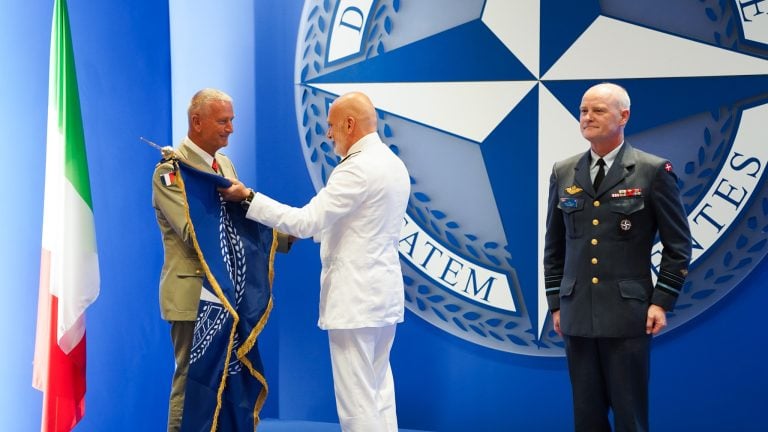
Lieutenant General Max A.L.T. Nielsen Hands Over NDC Command to Lieutenant General Jérôme Goisque Admiral Cavo Dragone hands over the NDC flag to the incoming NDC Commandant LGEN Goisque
  • Editor's Pick
  • News

Lieutenant General Max A.L.T. Nielsen Hands Over NDC Command to Lieutenant General Jérôme Goisque

July 18, 2026
Senior Course 148’s Graduation Marks 75 Years of Developing Future Leaders Course Member of Senior Course 148 saluting his flag
  • Courses
  • News

Senior Course 148’s Graduation Marks 75 Years of Developing Future Leaders

July 17, 2026
The NDC proudly celebrates its 75th anniversary & 60 years since its relocation to Rome The arrival of the Chairman of the Military Committee Admiral Guiseppe Cavo Dragone and NDC Commandant Lieutenant General Max A.L.T. Nielsen at the NDC's 75th Anniversary celebrations.
  • Courses
  • News

The NDC proudly celebrates its 75th anniversary & 60 years since its relocation to Rome

July 16, 2026
Video: The Mind as a Battlespace: Reshaping Education, Resilience and Decision-Making Video interview: CoC 2026
  • Editor's Pick
  • News

Video: The Mind as a Battlespace: Reshaping Education, Resilience and Decision-Making

July 7, 2026
Betting on blue: how to improve NATO military forecasting for acquisitions Outlook 07 2026
  • News
  • Publications
  • The War Series

Betting on blue: how to improve NATO military forecasting for acquisitions

July 6, 2026

CONTACT US

Central Registry
NATO Defense College
Via Giorgio Pelosi 1, 00143, Rome - Italy
E-mail: [email protected]

You may have missed

Outlook 2026-08
1 minute read
  • News
  • Publications
  • The War Series

Tactical datalinks: why they matter to the future of war

July 21, 2026
Admiral Cavo Dragone hands over the NDC flag to the incoming NDC Commandant LGEN Goisque
4 minutes read
  • Editor's Pick
  • News

Lieutenant General Max A.L.T. Nielsen Hands Over NDC Command to Lieutenant General Jérôme Goisque

July 18, 2026
Course Member of Senior Course 148 saluting his flag
5 minutes read
  • Courses
  • News

Senior Course 148’s Graduation Marks 75 Years of Developing Future Leaders

July 17, 2026
CMDT-FRA-2
2 minutes read
  • Who's Who

The Commandant

July 17, 2026
Central Registry
NATO Defense College
Via Giorgio Pelosi 1, 00143, Rome - Italy
Telephone: (+39) 06 50525 309 / 275
Fax: (+39) 06 50525 799
[email protected]
Public Information/media related matters:
[email protected]
Web related matters:
[email protected]
US Postal Address
U.S. National Support Element
NATO Defense College
PSC 802 BOX 201
FPO AE 09608-0003

UK Postal Address
Name Rank Number
Dept
NATO Defense College
BFPO 65

RELEVANT LINKS

NATO HQ
SHAPE
NATO ACT
NATO School
NATO Defense College Foundation
  • Organization
  • Education
  • Research
  • Engagement
  • Portals
  • Facebook
  • X
  • LinkedIn
  • Youtube
  • Instagram
  • Flickr
NATO Defense College © 2026 All rights reserved.
NATO Defense College NATO Defense College
Welcome back
Sign In
Sign in to access your downloads, manage your account, and continue where you left off.
Login Account
Enter your credentials to access your account
Forgot Password?
We use cookies to ensure that we give you the best experience on our website. If you continue to use this site we will assume that you are happy with it.