
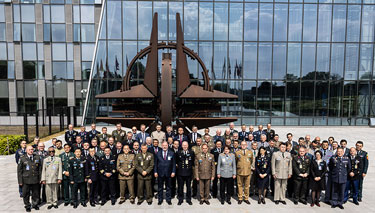
NDC delegation visits NATO HQ
NATO Headquarters was the venue for today’s programme.
In the morning, SC140 was welcomed by MGEN Francesco Diella (ITA A), Director of the International Military Staff (IMS) Cooperative Security Division, who remarked on the importance of the NDC’s primary role not only as the Alliance’s academic institution but also as a key contributor to cooperative security through its engagement activities.
In his speech, MGEN Diella underlined the NATO Secretary General’s view of partnership as a tool to increase security, preserve peace and promote stability; he also highlighted the three goals at the heart of the NATO 2030 initiative, i.e. “to keep NATO strong military, to make the Alliance stronger politically, and to adopt a more global approach”.
Col. Augusto Candido (ITA A), IMS Policy and Capabilities Division, provided the second briefing of the day, which outlined the June 2022 Summit, the new Strategic Concept and NATO 2030 as the main items featuring at the top of NATO’s current agenda.
In his preamble, Col. Candido focused on the Russian threat, which he said continued to test our resilience and undermine peace and stability in Europe, and on how NATO can counter new challenges through an increase in its armament capabilities, also stressing the importance of maintaining strong cohesion within NATO and with other international organizations.
The ensuing discussion covered a wide array of topics such as the NATO 2030 agenda, NATO’s evolution from NATO 1.0 to NATO 3.0, the NATO command and control architecture and decision-making process, and the impact of climate change on security. A compelling Q&A session concluded Col. Candido’s presentation.
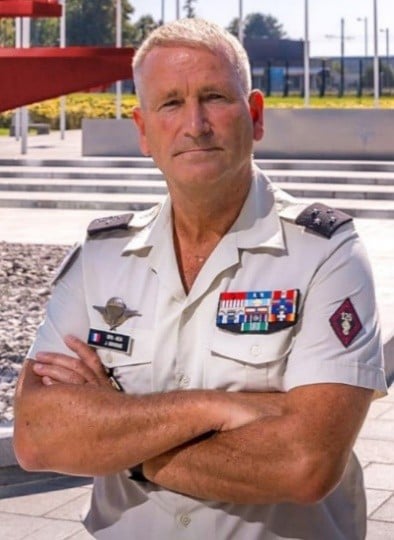
Next was a briefing presented by LTC Pierre Sandrin (FRA A), from NATO HQ’s Intelligence Production Unit, Joint Intelligence and Security Division, centred on security challenges, and in particular on those emanating from China.
In his presentation, LTC Sandrin provided an overview of Chinese military modernization, involving new aircraft, new nuclear capabilities and hybrid means; he noted increasing pressure to advance policies, as well as continuing progress on building a more robust overseas presence and adopting more realistic training scenarios. The presentation was followed by several questions from Course Members on future challenges to be expected from China.
Subsequently, Major Christoph Duerr (DEU A), Cooperation Policy and Programmes Branch, IMS Cooperative Security Division, gave a briefing about NATO Partners elaborating on MGEN Diella’s earlier presentation, providing an overview of NATO partnership programmes, and underlining a wide range of common areas of interest such as counter terrorism, hybrid, cyber technology, resilience and arms control.
Major Christoph Duerr specifically mentioned NATO’s partnerships with Australia, Japan, New Zealand and the Republic of Korea, including practical cooperative initiatives relating mainly to cyber security, maritime security and climate change.
The briefer stressed that partnerships mattered more than ever in view of the current security challenges and that the new Strategic Concept may impact the way NATO regards partnerships, observing that Asian Pacific partners had agreed an agenda for tackling shared security challenges.
Later, Course Members from NATO countries attended a classified presentation led by Col. Joachim Hahn (DEU AF), IMS Policy and Capabilities Division, on the NATO Defence Planning Process.
They were then joined by Course Members from NATO Partner countries for the last briefing of the day led by Col. Joeri Dsinter (BEL A), Head Operation Support Section, IMS Operations and Plans Division.
Col. Dsinter’s presentation focused on the workings of the Alliance in the field of crisis management, and gave a clear overview of NATO crisis management work, objectives and main actors, of interactions within NATO in this context and of the NATO Crisis Response Process (NCRP).
In the afternoon, some national representatives at NATO HQ organized briefings or meetings for co-nationals among Course Members and NDC staff.
This concluded the academic programme for the day and the Belgian part of Field Study 2.
NDC Public Affairs Office

 NATO Defense College