
With the end of the summer break, this month the NATO Defense College (NDC) begins the countdown for what will surely be another successful and eventful academic year. In the best tradition of the ottobrata romana, the warm days of September and October will be a particularly busy time. Not only have participants for Senior Course (SC) 123 just arrived from many different parts of the world, but over the coming months we will also be welcoming groups and delegations from a number of widely respected organizations – among them the Norwegian Defence University, the Norwegian Atlantic Council and the Baltic Defence College. Equally important, in mid-October, we will mark the 60th anniversary of the first Anciens’ reunion with an exciting programme of events. Last, but certainly not least, we are very pleased to announce the nomination of the College’s next Commandant, Gen Janusz BOJARSKI from the Polish Armed Forces – effective from summer 2014.
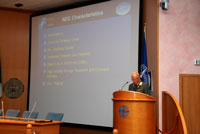
“We must constantly be on the lookout for individuals who are capable of adapting themselves to this new environment and who find it possible in a reasonably short period of time to broaden their outlook”: recalling Gen Dwight D. EISENHOWER’s words, NDC Commandant Lt Gen Arne Bård DALHAUG today (3rd September 2013) inaugurated SC 123. Over the next five months, Course Members will gain in-depth knowledge of current geopolitical dynamics and the role of NATO within today’s international setting.
A total of 79 participants are enrolled for SC 123, representing no fewer than 34 different countries. These include not only 21 NATO nations, but also countries belonging to the Partnership for Peace programme, the Mediterranean Dialogue and the Istanbul Cooperation Initiative, as well as Global Partners. Significantly, for the first time, this Course welcomes participants from the Islamic Republic of Pakistan and from Mongolia.
During SC 123, participants will be addressed by a varied pool of distinguished professors, ambassadors and senior military staff representatives. A range of topics will be covered: international organizations, particularly the UN, the EU and NGOs (week 4); the revised role of the Alliance in relation to the current geopolitical status quo (weeks 8 and 9, “NATO: Present and Future”); global security concerns, such as resources, the environment and weapons (week 13, “Global Security Challenges”); and current regional dynamics (weeks 19 and 20, “Regional Issues”, with case studies on the Caucasus, the Middle East, North and Sub-Saharan Africa, and Asia).
This comprehensive educational experience will be complemented by three Field Study trips, helping participants further develop the skills promoted and most required by the Alliance: consensus-building expertise, ability at critical analysis and reasoning, and the capability to work in a multinational environment.
As Commandant Lt Gen DALHAUG concluded in his inauguration speech, “All in all, there is a lot coming your way and initiative is crucial.” This remark appropriately captures the buzz of expectation which fittingly accompanies the start of the new academic year.
NDC Public Affairs Office
(Prepared by Ms Giulia Bruni Roccia, ITA C)

 NATO Defense College