
The five-day Study Period A2 on "The Changing Security Environment-The Strategic Context" consisted of lectures on the International Finance and Trade Systems, Religion and Conflict, Information and the Cyber World, Media and Strategic Communications, and Technology and Military Transformation. Senior Course 115 was joined by civil servants and officers from NATO agencies, who were attending a week-long Modular Short Course. The NATO Defense College runs these courses on a regular basis, in tandem with the 23-week Senior Course, to enable those who can only leave their offices for a limited time to enjoy the academic and professional challenges of NATO’s top-level academic institution in Rome.
The week started with very informative and complementary lectures on the “International Financial and Trade Systems”. Dr Mark ASPINWALL, a professor from the University of Edinburgh, introduced the topic and reflected on international institutions, while Mr Alastair NEWTON, a Senior Political Analyst at Nomura International plc, assessed the most current strategic changes and the economic crisis. The topic, a most relevant one today for dealing with the changing security environment, was presented by these two eminent experts in an academically rewarding and vivid way. Course members also benefited from the plenary Q&A and small group discussions.
The week continued with “Religion and Conflict”, another very sensitive and challenging topic.
Dr Claudio M. Betti , the Deputy Secretary General of the Community of Sant’ Egidio and Professor at the Pontificia Università Seraphicum, provided his opinion on the subject and an insight into the field work he has been involved in over the last few decades.
Mr Rami Khouri, the Director of the Issam Fares Institute for Public Policy and International Affairs at the American University of Beirut, delivered an enlightening lecture which focused mainly on the Middle East. He drew attention to key issues which could aid the West to analyse and better understand Islamic movements. These lectures generated an intense and profitable Q&A session.
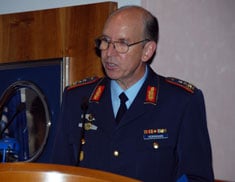
For the second time at the NDC, the subject of “Information and the Cyber World” was part of the curriculum. LTG Kurt Herrmann , the Director of the NATO Communication and Information System Services Agency, provided a thorough overview on the topic from an official NATO perspective. Course members had the benefit of a most informative lecture, followed by rewarding discussions on the challenges of the information age and how the Alliance is adapting itself to this relatively new environment.
Another day of the week was devoted to “Technology and Military Transformation”, a lecture given by the Dean of the NATO Defense College, Dr Grant T. Hammond , who discussed new technological achievements and their implications for security and defence matters. He emphasized the significance of today’s rapid technological improvements, the broad availability of related knowledge and the use of space by the Alliance.
The week ended with “ Media and Strategic Communications”, delivered by Dr Piers Robinson from Manchester University and Mr Mark Laity, Chief Strategic Communications at NATO.
Dr Robinson provided a thought-provoking presentation of research findings on the relationship between media and foreign policy. During his lecture he highlighted the differences between domestic and global non-Western audiences and concluded that, in the long run, it is policy that prevails and not news.
Mr Laity emphasised the enormous challenges the Alliance is facing in the field of communications, especially in the case of Afghanistan. He analysed the latest developments, drawing on his media background and experiences in NATO, and shared his thoughts on how NATO’s strategic communications could meet the challenges within the Alliance and in operations. The speakers initiated a lively exchange of views during both the Q&A period and the committee work.
NDC Public Affairs Office
 Collège de Défense de l'OTAN