
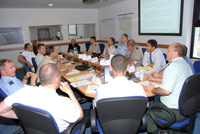
As the last academic event of Senior Course 116, Senior Course Members received lectures on the changing nature of Crisis Management, UN-NATO relations in Crisis Management, the NATO Crisis Management System and International and Multilateral Negotiations. These lectures were followed by a new Crisis Management Exercise/ Negotiation, Mediation and Decision-Making Exercise (CMX/NMDX), based on NATO CMX08 and CMX09.
First Mr Ted Whiteside, Secretary of the North Atlantic Council, provided a lecture on the most significant changes in crisis management recently. Dr Brooke Smith-Windsor focused on UN-NATO relations in crisis management, and Mr Ilay Ferrier, from the Crisis Exercising and Management Systems in the Operations Division at NATO HQ, explained how NATO Crisis Management works, the roles of the different bodies involved and the NATO Crisis Response System. He also stressed the importance of NATO’s contribution to an emerging Comprehensive Approach.
On Monday afternoon Mr Anthony Cragg, former Assistant Secretary General for Defence Planning and Policy, talked about practical approaches to conducting and participating in multilateral international negotiations, and outlined some of the options available to NATO in seeking to influence the development of a crisis.
After this briefing the Course Members formed their Working Groups for the rest of the week. As a last phase of their preparations, they held very fruitful discussions on key terms used in the exercise, e.g. NATO end state, with the speakers of the day as Senior Mentors.
Next morning, Gen (ret.) Harald Kujat, former Chairman of the Military Committee (MC), explained to the Course Members the role and functioning of the Military Committee in the case of Crisis Management. The exercise started immediately after this session.
During the exercise, the Course Members represented members of several senior NATO committees, including the Political Committee, the Military Committee, the Policy Coordination Group and the North Atlantic Council. Individual Course Members were assigned to act either in official positions on those committees, including taking the role of the Secretary General and the Chairman of the Military Committee, or as Representatives of individual NATO Nations, including as Permanent Representatives in the NAC.
The exercise scenario was a generic one, set on the fictitious Island of Roke, where three completely different countries were situated: Glefa, Mancy and Falun. The UN had already deployed a UN mission in the region of Gora, part of Mancy, one of the countries on Roke, but was not able to cope with the situation, which was further deteriorating as a result of the presence of the Goran Revolutionary Army, supported by Glefa, and the international terrorist activities of Halucha, a group protected by Glefa. The UNSG requested support from NATO to relieve the current UN mission with a NATO-led operation. The Course Members participated in a simulation of the various stages of the NATO Crisis Response System and practised negotiation, mediation and decision-making techniques.
They learned about group dynamics in a multinational negotiation process and were subjected to a complex process of multilateral consensus building in order to decide on a common course of action. The NATO and North Atlantic Council senior committees provided the ideal framework for this exercise, reflecting the strategic political-military level at which the Senior Course is focused. The Course Members in the role of NATO Secretary General and Spokesman also experienced what it is like to be “grilled” by the media and saw the results in the form of video clips and press articles.
Throughout the exercise, the Senior Mentors gave valuable advice and feedback to Course Members. The CMX/NMDX proved to be an academically challenging and enjoyable conclusion to the academic programme for Senior Course 116.
NDC Public Affairs Office

 Collège de Défense de l'OTAN