

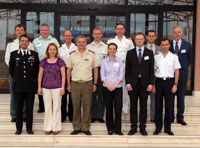
The aim of the SP is to ‘analyze global security challenges and the possible implications for NATO’. MSC 4, joined the SC for the SP, as well as many visiting Embassy staff.
Earlier in the Course, SC 118 had the opportunity to propose a vision of the world in 2025, outlining the future security environment within which NATO must work. SP D provided the chance to hear from experts in a number of specific fields to further inform committee views. At the end of the SP, committees will have the opportunity to identify, by consensus, the topic deemed most relevant to NATO, develop recommendations and offer them to the supervising Flag Officer and Faculty Advisor in the form of a presentation. The lecture content of SP D was as follows:
On Thursday 19 May Dr Nazrin Mehdiyeva, Dr Arif Husain, and Prof Sabomis-Helf presented the lecture “Resource Security: Energy, Water and Food”. Dr Mehdiyeva offered an excellent lecture covering numerous global energy issues, with valuable and thought provoking ideas for NATO’s role in Energy Security. Dr Husain provided an authoritative assessment of the world’s Food and security hotspots, linking the issues of energy commodities with food commodities in a clear way for the audience to consider. Prof Sabonis Helf completed the morning with an outstanding overview of water issues and how the politics of water may lead to security problems. Overall, the interaction of all three lecture topics, delivered by such an expert panel, provided Course Members with a taste for the complexity involved in Resource Security.
On Monday 23 May “The Environment and Consequences of Climate Change” was delivered by Professor Gwyn Prins and Dr Bruno Tertrais. Once again our visiting scholars provided a provocative and challenging set of lectures outlining to Course Members not only a fascinating and intelligent analysis of the key issues, but the methodology of how to think critically concerning the complex problem of Climate Change/Global Warming. Q&A ranged widely across the politics of Climate Change and treated Course Members to a stimulating and dynamic exchange.
On Tuesday 24 May “Demography and Migration” was delivered by Professor Peter Liotta. Once again Prof Liotta provided a fascinating and engaging brief on long-term global demographic trends, migration and the inter-related risks that this posed the world community. His lecture provided a helpful balance to previous speakers ideas. Overall, a very successful day with keen engagement from Course Members.
On Wednesday 25 May “Organised Crime” was presented by Dr Christina Schori-Liang and Mr Pierre Reuland. Both speakers provided a fascinating overview of International crime and criminality, stressing the complexity of global organized crime and its interaction with Terrorist organizations. In particular, Mr Reuland complimented Dr Schori Liang, by offering an Interpol perspective on key issues raised, outlining the key contribution INTERPOL makes in combating organized and international crime.
On Thursday 26 May “Terrorism” was delivered by Prof Edwin Bakker and Mr Thafar Maaitah. Prof Bakker and Mr Maaitah once again, offered an excellent overview of the phenomenon of Terrorism and its possible future trends, fielding many challenging questions during Q&A. The morning equipped committee members well for their afternoon intercommittee debate on the subject of Terrorism and deterrence.
The Study Period concluded on Friday 27 May with Professor Dr Holger Mey and Mr Edmund Whiteside delivering a lecture on “Weapons of Mass Destruction, Proliferation and Arms Control”. Professor Mey offered a clear and thought provoking analysis of the key issues, challenging CMs to think through the structure and logic of proliferation, with additional thoughts on Ballistic Missile Defence. Mr Whiteside provided an outstanding overview of the current status of NATO thinking on WMD and WMD proliferation and both panellists treated Course Members to an exemplary Q&A session.
Throughout the six days of “Global Security Challenges” CMs and MSC colleagues had the opportunity to analyse the complex and inter related nature of the SP topics. Feedback already shows that the effort was well worthwhile and that the SP achieved its aim.
NDC Public Affairs Office


 NATO Defense College