
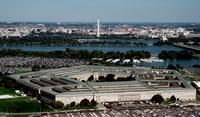
On the final day in Washington, D.C., 10 May 2011, NDC Course Members toured the historic halls of the Pentagon.
After the tour, Capt (Navy ret.) George McCaffrey, a former member of NDC staff, moderated a series of lectures. BGen Steven KWAST, Deputy Director for Europe, NATO and Russia in the Joint Staff presented the USA view on NATO. He stressed the important role of peacemaking for NATO, the necessity to build relations of trust with all partners and to analyse permanently the geostrategic environment. This briefing was followed by a common presentation by Mr Fred Robertson and Mr Mark Jones, working for the Deputy Director Assistant Secretary of Defence, European and NATO policy, Mrs Julianne SMITH, who was not able to brief the Senior Course this time. They both focused on Libya and the lessons learned. Mr Robertson covered the strategic level and Mr Jones discussed the more operational aspects.
Col Dan Wilson, USMC, Pakistan Afghanistan Coordination Cell gave a very interesting and intensive briefing on the current operations in Afghanistan and relations with Pakistan.
The last briefing of the day was provided by Capt Wayne PORTER, USN, Special Assistant in the Office of the Chairman of the Joint Chiefs of Staff. He presented his individual vision on the way to develop strategies in an innovative way. He illustrated his explanation in approaching the problem comparing it with laws in physics. In his viewpoint we should pass from a strategy of “containment” to a strategy of “sustainability”.
All of the presentations were followed by question and answer sessions that were both thought-provoking and engaging. After visiting the 9-11 memorial SC 118 travelled to New York, the last stop during this Field Study.
On the last full day of the Transatlantic Link Field, SC 118 received briefings on the United Nations (UN).
Col P. VAN DER HEIJDEN and Ms E. LEMOS-MANIATI, the NATO Military and Civilian Liaison Officers, gave an extensive and interesting introduction to the Peacekeeping Operations, on the relations between UN and NATO, their coordination and the current issues.
Mr Hors HAIDMAN, from the Department of Political Affairs (DPA), briefed SC on the role and the tasks of the Department. He also stressed the fact that DPA is dependent on information provided by the Nations or by public means for its intelligence and assessments, because the UN doesn’t have Embassies.
The Chief Current Military Operations/Office of Military Affairs (CMOS/OMA), Department of Peacekeeping Operations (DPKO), Col (Rtd) W. VAN DULLEMEN, gave an excellent and very detailed presentation on the place of OMA in the UN structure, on the UN’s peacekeeping operations and the challenges faced by his office and by the UN. He was assisted during the Q&A period by Col Andreas JODECKE, OMA responsible for the Assessment Team.
Each of the previous briefings was concluded with a Q&A session, which gave the CMs the opportunity to deepen their understanding of the UN, its relations with other International Organisations and its Peacekeeping Operations.
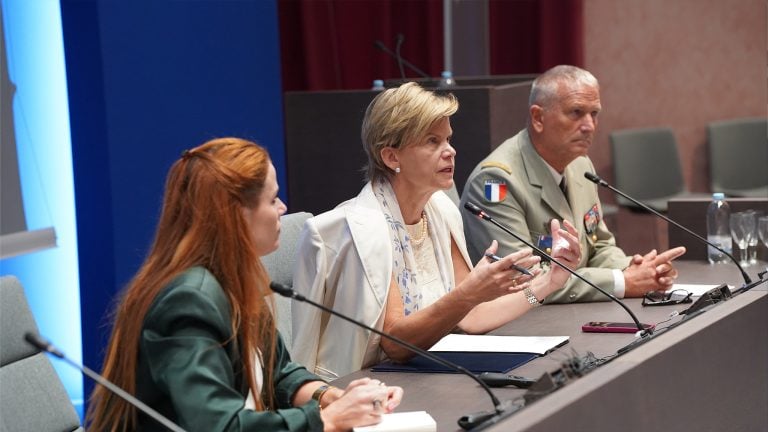
The morning session ended with a panel-discussion with the Deputy Military Advisors of the five Permanent UN Security Council Members (P-5). Each representative introduced himself and explained briefly his national position in the UN. The following discussion allowed the SC118 to receive first-hand information on a lot of different questions, mainly related to Libya.
After these briefings, the Dean of the NATO Defense College, Dr Richard HOOKER, thanked the Faculty and Staff for the organisation of this Field Study and he also congratulated the Course Members for their active participation. This concluded a very successful and informative Field Study.
More about the Field Study:
First stop – NATO HQ, Brussels
Second leg – Belgian Defense Staff and to Supreme Allied Headquarters Europe (SHAPE)
 NATO Defense College