

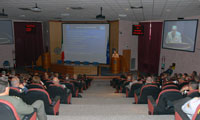
Today is an important day for the new Course Members attending Senior Course 119, who were welcomed at this morning’s SC 119 Inauguration Ceremony by LtGen Arne Bård DALHAUG, Commandant of the NATO Defense College in Rome.
During his introductory remarks the NATO Defense College Commandant underlined the importance of studying in a real international environment, where consensus and human interoperability have to be achieved day by day through sustained commitment.
After the Commandant, the College Dean, Dr. Richard Hooker, took the floor to welcome Course Members. He explained in detail the fundamental Course objectives — namely that, even more than gaining knowledge about NATO, participants should develop consensus-building skills, increase their ability at critical analysis and reasoning, and become accustomed to working in a multinational environment.
Over the next six months, Course Members will be engaged in discussions centred on the different parts of the NATO Defense College’s curriculum, and will be able to gain more insight into the various perspectives and approaches currently promoted by NATO. In addition, the importance of partnership and cooperation will be strongly promoted as essential practices to be cultivated throughout the course – and, indeed, across the full span of each individual’s professional life.
The 76 course participants are from a total of 28 countries, not only within NATO but also from the Partnership for Peace Programme, the Mediterranean Dialogue, the Istanbul Cooperation Initiative and Iraq. In addition, for the first time in the College’s history the group will be completed by a delegate from Serbia.
The Senior Course is the College’s core business, covering a range of topics relevant to international security and defence: the Global Security Environment and Global Security Challenges, International Organizations, NATO’s Present and Future, Regional Studies, Field Studies, and a Crisis Management Exercise. The Modular Short Courses (MSC) and Integrated Partner Orientation Course (IPOC) overlap with portions of the Senior Course, as do parts of the NATO Regional Cooperation Course (NRCC).
During the course, the entire group of participants complete three Field Study periods, dedicated mostly to NATO capitals and Headquarters so that Course Members can receive direct updates on topical issues from senior officials. While NATO Headquarters, Allied Command Operations and Allied Command Transformation provide an overall picture of the Alliance and its plans and operations, it is when they spend time in the capitals that Course Members actually have the chance to see and hear how nations go about policy-making. Following these Field Studies, the College requires analytical papers from each committee, with a detailed account of the perceived state of transatlantic relations and of national contributions to the Alliance.
There are two capstone exercises during the final weeks prior to graduation. The first is a three-day political simulation at the North Atlantic Council level, to deal with several consensus-stressing threats to Alliance security that demand action. The second is the presentation of each committee’s Study Project – an in-depth look at a topic affecting Alliance security, approved by the Faculty early in the course. Both a written analytical paper and an oral presentation are required.
NDC Public Affairs Office
(Prepared by Ms Kyla Cham, CAN C)


 NATO Defense College