
Senior Course 121 (SC 121) continued its third Field Study (FS 3) with a visit to the Azerbaijan Diplomatic Academy (ADA) in Baku, on 17th December.
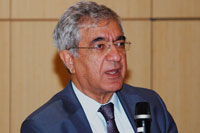
H.E. Ambassador Hafiz Pashayev, Founder and Rector of the Academy, extended a warm welcome to the NATO Defense College (NDC) group, led by NDC Commandant Lieutenant General Arne Bård Dalhaug (NOR A). The NDC leadership was also represented by the Dean, Dr Richard D. Hooker (USA C), and by the Director of the Academic Planning and Policy Division, Brigadier General Gerd Bischof (DEU F).
In his address, Ambassador Pashayev presented the role of the Azerbaijan Diplomatic Academy in specialist professional education for diplomats and civil servants with international duties. Deputy Rector Mr Fariz Ismayilzade then provided an extensive overview of the ADA’s courses, which are taught at the School of Public and International Affairs, the School of Business, and the School of Humanities and Sciences. A total of 289 students are currently enrolled. Proud of its global vocation and its committed approach to development of mutual understanding, the ADA recruits both academic staff and students internationally. NATO Secretary General Anders Fogh Rasmussen has visited the Academy as a guest lecturer, as have several high-level speakers from the Russian Federation.
H.E. Araz Azimov, Deputy Minister of Foreign Affairs, was the second speaker of the day. Having addressed the NDC in Rome early last year as a guest lecturer, Mr Azimov was particularly appreciative of SC 121’s visit to Baku and of the opportunity for Course Members to learn more about Azerbaijan’s international relations. Underlining the importance of continuing engagement with partners in the field of education as a mainstay of dialogue, he thought it sensible for NATO to focus more on development of specific bilateral partnerships than on enlargement true and proper. Mr Azimov spoke of the Azerbaijani non-alignment policy in a broad Eurasian security perspective, against a background of growing concern about possible regional instability following the NATO withdrawal from Afghanistan in 2014. In this respect, it should be noted that Azerbaijan’s Ministry of Foreign Affairs has made provision for NATO to use Azerbaijani transit routes and infrastructure as part of the necessary arrangements for withdrawal. A positive corollary of this agreement is that it provides a stimulus for the country to upgrade major roads and harbours on the Caspian Sea.
The following speaker was Major General Najaf Gambarov, Commandant of the Armed Forces War College, who acknowledged the NDC’s contribution to the education of Azerbaijani officers and diplomats. On the subject of military education and training, MajGen Gambarov mentioned Azerbaijan’s cooperation with a number of international partners. He also illustrated the structure and academic activities of the National War College, which educates officers according to NATO programmes so that Azerbaijani troops can be trained to the highest standards and maximize interoperability with NATO forces. The speaker then commented on Azerbaijan’s significant defence reforms, as well as its contribution to international missions such as ISAF and KFOR. Military cooperation with other countries is increasingly a priority, as indicated by the growing number of military attachés at Azerbaijan’s embassies in various parts of the world.
After this, Lieutenant Colonel Shahin Rzayev from the Ministry of National Security gave a briefing on modern security challenges. Building on lessons learned from the experience of Azerbaijan’s special services, the speaker identified a number of particularly significant current threats: aggressive separatist movements, international terrorism and religious extremism. LtCol Rzayev listed recent terrorist attacks experienced by Azerbaijan and referred to several known terrorist groups, before concluding with some remarks about the ongoing development of specific legislation to counter terrorism.
The day’s intense and rewarding agenda was completed by Mr Vilayat Valiyev of the Ministry of Economic Development, who is Director of the Institute for Scientific Research on Economic Reforms. He provided an authoritative overview of the Azerbaijani economic system, highlighting the achievements of recent decades and the substantial investments in strategic infrastructure. Significant results of these investments include pipelines from Baku to a number of cities and harbours in Georgia and Türkiye, as well as the state-of-the-art Sangachal oil terminal near Baku. Such assets enable Azerbaijan to satisfy 1% of the European demand for oil, and have contributed to the rise in per capita income which the country has achieved in recent years.

 NATO Defense College
