
After the very successful North American leg of its Transatlantic Link Field Study, Senior Course 122 (SC 122) flew back to Europe for a final round of institutional briefings and visits in Belgium.
The itinerary for this final part of the Field Study left time for a brief stop in the historic city of Bruges, before moving on to Brussels. Here, a very full schedule on Wednesday 8 May included detailed briefings and discussions at NATO HQ in the morning, and at the European Union (EU) in the afternoon. This enabled Course Members to gain a better understanding of the ties between the two organizations.
The group was welcomed to NATO HQ by the Deputy Chairman of the Military Committee (CMC), Lieutenant General Walter GASKIN (USA A). Commenting on the essential role of partnerships for the Alliance, he described the challenging strategic landscape and major on-going NATO operations (Afghanistan, Kosovo, Operation Ocean Shield, Operation Active Endeavour, the integrated air defence and ground-based missile defence systems in Turkey, Baltic air policing). The speaker then focused on the three major current challenges of the Alliance: the economic crisis, the strategic rebalancing of NATO, and the integration of partners. He afterwards engaged in a very candid exchange with Course Members, tackling a number of difficult issues like the current situation in Syria.
The next speaker was Dr Detlef PUHL, Senior Adviser Communication at the Emerging Security Challenges Division within NATO’s International Staff (IS). This presentation focused on the Alliance’s answers to the emerging challenges identified in the Lisbon 2010 Strategic Concept, like terrorism, proliferation of WMD, cyber threats, limited access to resources and energy security.
In a very clear and comprehensive presentation, Mr James APPATHURAI, Deputy Assistant Secretary General for Political Affairs and Security Policy, focused on the current political challenges and priorities of the Alliance, like the on-going transition process in Afghanistan and prospects after 2014, the transformation of NATO in a period of austerity, the need to train and exercise in order to maintain acquired interoperability, security challenges related to new technologies (e.g., cyber defence, missile defence), relations with Russia, and major partnerships (in particular with the African Union, the Arab League, and other international organizations).
Colonel Patrick ANDREWS, OBE (GBR A), Deputy Director of the Comprehensive Crisis Operations Management Centre (CCOMC) at SHAPE, then briefed SC 122 on NATO’s current operations. He spoke in detail about the Alliance’s level of operational commitment, focusing in particular on the current transition process in Afghanistan, redeployment issues, future planning, and the role of the CCOMC.
The last speaker was Ambassador Francesca TARDIOLI, NATO’s Deputy Assistant Secretary General for Planning in the IS Operation Division. She gave a very detailed description of the Civil Emergency Planning process, the role of the four Planning groups (Transport – Health, Agriculture and Food – Industrial Resources and Communications – Civil Protection) and the Euro-Atlantic Disaster Response Coordination Centre (EADRCC), as well as the challenges arising from the current Strategic Concept.
Each of the briefings was followed by a lively Q&A session. In addition, Course Members had an opportunity to talk with national representatives over lunch.
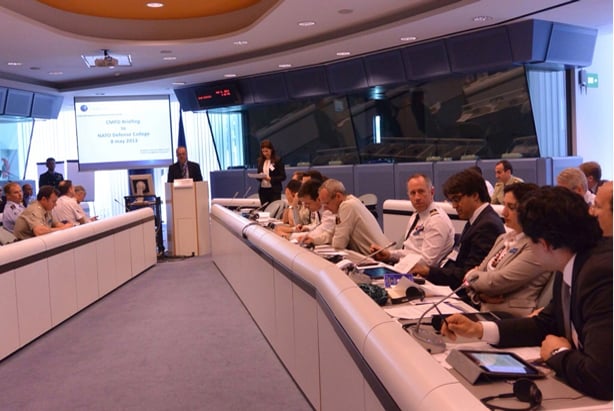
Following this very fruitful morning at NATO HQ, SC 122 then visited the Council of the European Union for a detailed session on the role of the EU in crisis management, its institutional and operational links with the Alliance.
The session began with a welcome address by Lieutenant General Anton VAN OSCH (NLD A), Director General of the EU Military Staff (EUMS). He used his introductory remarks to underline several features of the EU’s involvement in military affairs. First, “the Comprehensive Approach is working”, with EU diplomacy playing an important role. Second, the EU’s role is in no way to duplicate NATO efforts and resources, but to complement them. Third, the EU’s international presence is not limited to “soft” power. The speaker used different examples to illustrate the role of the EUMS, explaining how it can be seen as complementary to that of NATO.
Brigadier General Walter HUHN (DEU F), Deputy Head of the Crisis Management and Planning Directorate (CMPD), then addressed Course Members on strategic and current issues related to the EU’s Common Security and Defence Policy (CSDP). In a comprehensive survey based on the European Security Strategy (2003/2008), the speaker covered the development of the External Action Service, the EU crisis management structure, and cooperation with NATO in current operations.
He was followed by Brigadier General Pascal ROUX (FRA), Director of the Concept and Capabilities Directorate (CONCAP) at the EUMS, who spoke about EU capabilities’ development and, more generally, the place of the military within the EU organization. He underlined the similarities between the EU’s planning process and that of NATO.
The final speaker was Colonel Luigi BRUNO (ITA), from the Planning and Methodology Section at the Civil Planning and Conduct Capability (CPCC), EUMS. He updated Course Members on the civilian contribution to integrated operations in the EU’s “comprehensive approach” to crisis management, and on EU civilian capability development.
Before the return journey to Rome, SC 122’s Transatlantic Link Field Study concluded with a reception hosted by the Chairman of the NATO Military Committee (CMC), General Knud BARTELS (DAN A) (represented by his Deputy, LtGen Gaskin) and the Belgian Chief of Defence (CHOD), General Gerard VAN CAELENBERGE, with the active participation of the Belgian Association of NDC Anciens. This was an excellent opportunity to meet and interact with a number of Anciens.
 NATO Defense College


