
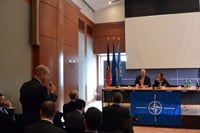
Senior Course 122 (SC 122) started the North American leg of its Transatlantic Link Field Study on April 30th in New York City. The day was dedicated to a very informative briefing session with representatives of the United Nations (UN) and the World Bank (WB). As is customary when the SC is briefed by UN officials, the event was kindly hosted by the German House: close to the UN building, this is the seat of the Permanent Mission of Germany to the UN. The group was warmly welcomed by First Counselor Karl-Heinz Weidner, who is Germany’s Police Adviser for United Nations Peacekeeping Missions.
Colonel Paul Van der Heijden, NATO’s Military Liaison Officer to the UN, began the session. After briefly mentioning the current state of the ongoing reconstruction work on the UN building, he spoke about UN-NATO relations and gave an overview of the 15 current UN Peacekeeping Operations (PKO), which involve a total force of 115,000 (including civilian, police and military personnel) from around 115 countries. Ms. Eirini Lemos-Maniati, NATO’s Civilian Liaison Officer to the UN, highlighted the various developments in UN-NATO cooperation, including the 2008 Joint Declaration and the NATO contribution to the Comprehensive Approach. Dwelling on the lessons learned from different operations (the Balkans, Afghanistan and Libya), she highlighted the challenges involved, but also the major improvement in practical cooperation between UN and NATO over the years. The lively Q&A session which followed ensured that the day’s discussions got off to an excellent start.
The next speaker was Mr Jack Christofides from the UN PKO Office of Operations, who described the various steps and challenges in a PKO. Starting from the role of the UN Security Council (UNSC) in establishing the initial mandate, the speaker followed the entire process through to its implementation on the ground, including an explanation of the role played by regional organizations and neighbouring countries. The examples of recent operations in the Democratic Republic of the Congo, Mali and Somalia were particularly useful illustrations of this complex process.
Course Members were then briefed by Colonel James Cunliffe, Special Assistant to the Office of Military Affairs (OMA) in the Department of Peacekeeping Operations (DPKO). He gave them a comprehensive overview on the organization and functions of the OMA, as well as current UN approaches to PKO. The speaker focused on the principle of the Responsibility to Protect (R2P) civilians, the concept of robust peacekeeping under a suitable mandate, the challenges of generating operational forces and core military capabilities, and the need for capability development. Lieutenant General Babacar Gaye, Military Adviser to the UN Secretary-General for Peacekeeping Operations, then drew on his unique experience of the UN system to address a number of very searching questions from Course Members. Lt Gen Babacar’s very personal and direct manner afforded an excellent complement to his wealth of practical knowledge, making this discussion one of the highlights of the visit.
The session continued with a panel discussion with Advisers from the five Permanent UN Security Council Members (P-5): Senior Colonel Zang Tsu (China); Brigadier General Jean-Luc Friedling (France); Colonel (ret) Sergueï Yakushev (Russia); Colonel Guy Denison-Smith (UK); and Lieutenant Colonel Curt Velasques (USA). After briefly introducing himself, each representative summarized the major features of his nation’s position on current UN matters. The panel gave Course Members insightful answers on a wide range of issues, from the role of military advice in the UNSC decision-making process to the perception of NATO in the UN, the situation in Syria and the need for reform of the UNSC.
For the first time, the Senior Course also had a unique opportunity to meet the WB representative at the UN, Ms Dominique Bichara. She spoke about the mission, organization and structure of one of the world’s two main financial institutions (the other being the International Monetary Fund, the IMF), explaining the WB’s almost universal membership (188 members), the principle of its independence and its resources. She emphasized the role of both the WB and the IMF in reducing poverty and solving the world’s most pressing developmental challenges. Within this overall setting, Course Members had an opportunity to learn more about the essential role of security and stability in the development of a country. The quality of the exchanges following the lecture indicated keen interest in organizing further meetings of this kind for future Senior Courses.
SC 122 will now continue its Field Study with visits to Norfolk (ACT) and Washington DC.
NDC Public Affairs Office
 NATO Defense College


