
NATO Defense College (NDC) Senior Course 122 (SC 122) concluded the North American leg of its Transatlantic Field Study in Washington DC, from 3 to 6 May 2013.
On Friday 3 May, the group went to the Pentagon for several US Joint Staff briefings.
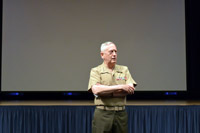
General James N. Mattis, USMC, welcomed the NDC delegation. The former US Central Command (CENTCOM) Commander and – before that – Supreme Allied Commander Transformation (SACT), who has completed more than 41 years of distinguished service in the US Marine Corps, used this opportunity to present his vision of the world security landscape. Underlining the values and moral principles of our Alliance, he fascinated Course Members with his wise and insightful strategic thinking, describing current security challenges and the role of modern leaders. A lively question-and-answer period followed, with the speaker receiving a standing ovation at the end: this exchange was certainly a major highlight of the Transatlantic Link Field Study.
The next speaker was the Vice-Director for Strategic Plans and Policy (J-5), Major General Rock, who provided an extremely pertinent overview of the US’ strategic orientation and of the planning process behind joint military operations. He illustrated the priorities to be addressed by the Pentagon and engaged Course Members in an informative exchange, underlining the need to expand interagency and international cooperation as a key to success in current operations and in facing major challenges such as terrorism and cyber threats.
SES James J. Townsend Jr., Deputy Assistant Secretary of Defense for European and NATO Policy at the Pentagon, then spoke about current US security policy regarding the future of the Alliance and discussed possible future scenarios for US-EU relations. This talk was followed by a challenging Q&A session, covering the concept of Smart Defense, the rebalancing of the US to the Pacific region and its consequences for relations with Europe, budget cuts, and the challenges linked to NATO’s open door policy
After the Pentagon briefings, the NDC delegation visited Capitol Hill, where Course Members were welcomed by BG Rudder, Legislative Assistant to the Commandant of the Marine Corps. During his opening remarks, he emphasized the role of the different Armed Forces Committees and explained how they contribute to the legislative process.
The next speaker, Mr Tom Hawkins, National Security Advisor to the Republican leader, described the role of Congress in the national security apparatus.
After a lively Q&A session, SC 122 received an informative briefing from the Senate Historian, Dr Don Ritchie. He provided a comprehensive historical overview of the US Congress and the relations between its two houses, the House of Representatives and the US Senate. This gave participants a greater understanding of the US legislature and provided a useful basis for the ensuing discussions.
The next briefing was given by Mr Paul Arcangeli, Minority Staff Director, House Armed Services Committee. Focusing on the role of the House of Representatives, he gave a comprehensive overview of the National Defense Authorization Act, a law which controls defense budget expenditures.
Professor Charles B. Cushman, from the Government Affairs Institute at Georgetown University, then gave a fascinating talk on Congressional oversight of the US’ 17 intelligence agencies, explaining how Congress ensures that their work is appropriately coordinated in timely support of the presidential agenda. The ensuing
discussion was very entertaining, direct and fruitful for the Course Members.
To finish this long and productive day, the group attended a reception at the Marine Corps Barracks in Washington. Here, Course Members had a chance to talk with several general officers and defense attachés. After the reception, the Senior Course was invited to attend an exceptional Evening Parade featuring the Marine Corps Band and the USMC Silent Drill Platoon. Known as “The Marching Twenty-Four”, this 24-man rifle platoon exemplifies the discipline and professionalism of the Marine Corps.
 NATO Defense College


