
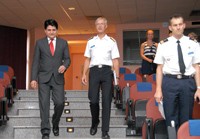
During the period 7 – 10 June and 28 June – 1 July 2011, Senior Course 118 continued its in-depth studies of major geographical regions within and beyond the North Atlantic Treaty Organization (NATO) territory, from a general global perspective as well as from the NATO point of view. Particular emphasis was placed on their impact on regional (and global) stability or instability, and what this means for the Alliance. During the academic programme, a series of visiting experts offered their thoughts on Sub-Saharan Africa, the Middle East, and Central, North-East and South Asia.
The second part of SP E started with a session on Sub-Saharan Africa, the Sahel and the Horn of Africa. Two qualified panellists, Dr. Greg Mills from South Africa, head of the Brenthurst Foundation, and Dr. Mahmoud Mohamedou, a Mauritanian and USA citizen, Associate Fellow and Visiting Professor at the Graduate Institute of International and Development Studies in Geneva, discussed the complexity of challenges facing Sub-Saharan Africa and, indirectly, the Alliance. Violence, political turmoil and uncertainty are rife in many parts of the continent, compounding the problems of inequality, food insecurity, climate change and lack of jobs for the young. The two speakers offered a comprehensive analysis not only of the continent’s enormous potential, but especially of the risks in years ahead, related to the variety of issues and challenges that have to be addressed by the international community and by the peoples of the African continent.
Two of the Study Period sessions were devoted to the Middle East. Visiting lecturers were Prof. George Joffé from Great Britain, Prof. Mazin Quimsiyeh, a USA citizen of Palestinian origin, and Mr Yossi Mekelberg, an Israeli/British citizen. The Middle East is an area of global strategic importance that faces huge challenges, including modernization and reform, the development of basic democratic and human rights, education and literacy, the reduction of poverty and the need to manage an upsurge of Islamic radicalism. In the light of the Middle East and North African protest movements calling for political reforms, it is interesting to discuss the likely outcomes. Against this background Prof. Joffé offered an in-depth analysis of present and future security issues and challenges in the region, focusing on Iran, Iraq and the Gulf. Prof. Quimsiyeh and Prof. Mekelberg examined more closely one of the longest-lasting and at the same time most explosive of all the world’s conflicts, between the Israelis and Palestinians, helping the audience to understand the wide range of underlying issues.
Dr. Shirin Akiner, former Professor of Central Asian Studies at the School of Oriental and African Studies of the University of London, and an “Honorary Ancien” of the NDC, provided Course Members with a profound analysis of the five Central Asian states, putting into perspective differences and commonalities as well as the challenges ahead. She assessed the risk of further deterioration in the economic and security climate in Central Asia. Dr. Akiner’s lecture greatly enhanced Course Members’ understanding of the region and triggered a lively discussion.
Throughout the world the media have determined that this will be the “Asian century”. The lecture focusing on China, North East Asia, Japan and the Koreas was delivered by Dr. James Boutillier, special adviser to the Canadian Maritime Forces and an “Honorary Ancien” of the NDC. He examined why the region is increasingly important and considered the changing political geometry of the area, the rise of China and the relationship between Beijing and Washington, as well as with other regional players. The rise of China is a phenomenon that can be considered either an opportunity or a challenge. North East Asia can no longer be seen as a remote and isolated region: developments there impinge on the West in every way and should therefore be observed closely. The relationship between North and South Korea remains an unresolved legacy of the Cold War. Since their division, South Korea has developed into one of Asia’s most affluent countries, but the North has slipped into starvation and poverty, while maintaining huge military capacity and claiming legitimate recognition as a nuclear-armed state. Meanwhile, Japan has seriously reviewed its current security policy, largely driven by the perceived military threat from North Korea, and is also reviewing its so-called “peace constitution”, allowing for greater flexibility in the deployment and use of its military forces. Dr. Boutillier’s lecture, as always, gave Course Members profound insight into the subject matter and an understanding of the region and its importance for the international scenario.
The speakers on South Asia, covering Pakistan and Afghanistan, were Dr. Samina Ahmed, Project Director for South Asia at the International Crisis Group, Islamabad, Pakistan, and Dr. Richard D. Hooker Jr., Dean of the NDC. Within the region, sources of instability include bitter inter-state and intra-state conflict, nuclear and missile proliferation, terrorism, religious extremism, separatism, demographic pressures and drugs. Both speakers agreed that the international community should be concerned by the internal tensions in Pakistan, in relation to future developments and also to the security situation in Afghanistan. Dr. Hooker gave a profound analysis of the state of affairs in Afghanistan. As this topic is of great concern to NATO, it triggered lively interaction between the Course Members and the panel.
The second part of SP E ended with a lecture on India, one the world’s economic giants, vying with China in its growth rate. The lecture was delivered by Dr. Harsh Pant of the King’s College Defence Studies Department, London. During the last decade India has continued to emerge as a major power and has experienced remarkable economic development. It plays a key security role in South Asia. Dr. Pant’s detailed insight into the complexities of state affairs and security challenges in India, as well as in the region as a whole, was therefore particularly relevant.
Overall, it was a highly rewarding academic program, with a range of thought-provoking and stimulating lectures which offered an introduction to some of the important issues in the regions discussed. The NATO Defense College and the Senior Course were privileged to be addressed by such a distinguished group of high-level experts. It was an excellent opportunity not only to improve understanding of regional issues, but also to consider contemporary security concerns in an era of global interdependence.
NDC Public Affairs Office
 NATO Defense College