
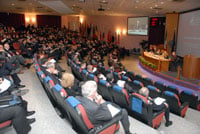
On 5th and 6th February 2013, the NATO Defense College (NDC) in Rome hosted the 58th Conference of the Atlantic Treaty Association (ATA).
The aim of the two-day event, organized by the ATA with the logistic support of the College, was to promote discussion and research on security issues and topics relevant to NATO in particular, and to the international security community as a whole.
In giving his inaugural address, NDC Commandant Lieutenant General Arne Bård Dalhaug (NOR A) had the honour of welcoming a number of distinguished speakers: H.E. Giulio Terzi di Sant’Agata, Italian Minister of Foreign Affairs; H.E. Admiral Giampaolo Di Paola, Italian Minister of Defence; H.E. Arben Imami, Minister of Defence of Albania; the Hon. Franco Frattini, President of the Italian Society for the International Organization (SIOI); the Hon. Karl A. Lamers, President of the Atlantic Treaty Association; and the Hon. Prof. Enrico La Loggia, President of the Italian Atlantic Committee (IAC).
LtGen Dalhaug praised the activity of the ATA as a forum for fostering dialogue and research, hence helping promote the values of the Alliance, its mission and objectives. He then left the floor to the Hon. Enrico La Loggia, who gratefully acknowledged the support received from LtGen Dalhaug, the NATO Defense College and the many authorities present. The Hon. La Loggia also offered the audience his assessment of the steps needed to achieve dialogue and cooperation between leaders from NATO, the Mediterranean area and the Gulf region.
The following speaker was the Hon. Franco Frattini, President of SIOI and official candidate of Italy for the position of NATO Secretary General. He stressed the importance of NATO for today’s security environment, providing an overview of the major challenges and opportunities that the Alliance is set to face in the foreseeable future. Particular emphasis was given to cyber security and to its implications, given the potential grounds for invoking articles 4 and 5 of the Washington Treaty in response to cyber threats. The next speaker in succession, the Hon. Karl Lamers, also focused on current and future threats for the Alliance. In addition, he stressed the importance of a reasoned and efficient implementation of the concept of Smart Defence, as decided during the Chicago Summit in May 2012.
H.E. Giampaolo Di Paola, Minister of Defence of the Italian Republic and an ancien of the NATO Defense College, then took the floor. In an inspiring speech, he prioritized the need to ensure the Alliance’s prescient and timely adaptation to the far-reaching changes occurring in rapid succession throughout an increasingly connected and globalized world. Admiral Di Paola also encouraged the younger members of the audience to embrace change and to be an active part of it.
The next speaker was H.E. Arben Imami, who offered a topical and relevant overview of the progress achieved by Albania in terms of interoperability with the other components of NATO’s integrated military structure. In a broader perspective, H.E. Giulio Terzi di Sant’Agata spoke of the interrelation between human rights and security, as well as the importance of reviving and reinforcing the Alliance’s links with the European Union in a true spirit of collaboration. Partnerships and Smart Defence-related initiatives were also singled out for comment, given the attendant advantages both for NATO and for individual member states like Italy.
The day continued with two forums, the first of which was dedicated to the analysis of the NATO 2020 initiative. Chaired by Dr Karl-Heinz Kamp, Head of the NDC Research Division, the panel comprised: Dr Frances G. Burwell, Vice President of the Atlantic Council of the United States; Prof. Julian Lindley-French, a member of the Atlantic Council’s Strategic Advisors Group; Prof. Tanja Miscevic, from the University of Belgrade; Prof. Stanislav Tkachenko, from the Saint Petersburg State University; and H.E. Ambassador Gabriele Checchia, Italian Permanent Representative to the North Atlantic Council. The lecturers provided an attentive audience with a comprehensive overview of the NATO 2020 agenda, its challenges and the resulting impact on national policies.
The second forum was entitled “Cooperative security in the Mediterranean and in the Middle East”. Under the chairmanship of Mr Fabrizio Luciolli, Secretary General of the Italian Atlantic Committee, the panel brought together the following speakers: Mr Nicola De Santis, from the NATO PASP Division; Prof. Khaled Fouad Allam, from the University of Trieste; Dr Yasemin Taksin, Sabah columnist; Mr Oraib Al-Rantawi, Director of the Al-Quds Center for Political Studies; and Major General Danny Rothschild, Director of the Institute for Policy and Strategy at the Interdisciplinary Center Herzliya. The speakers provided varied and detailed perspectives on the complex scenario of diplomatic and military action in the Middle East, looking at the implications not only for regional security environment but also for NATO.
On the second and final day of the Conference, there was a forum on modern defence and economic development. Chaired by Admiral Ferdinando Sanfelice di Monteforte, President of the Military Committee of the Italian Atlantic Committee, the panel included: Lieutenant General Gian Marco Chiarini, Italian representative to the NATO and EU military committees; Dr Antonio Perfetti, MBDA Italy; and Mr Shai Blitzblau, CEO at Maglan Information Technologies Ltd. The discussion shed valuable light on issues related to cyber security, for NATO members and partners alike. Areas such as procurement, threat assessment and operational response were addressed thoroughly and methodically, from the perspective both of governments and of academic institutions.
Closing remarks were offered by the Hon. Prof. Enrico La Loggia and by LtGen Dalhaug, bringing proceedings to a very successful conclusion in terms of the interest generated by the varied and highly topical programme of the 58th ATA Conference.
NDC Public Affairs Office
(Prepared by Ms Eleonora Fuser, ITA C)
 NATO Defense College


