

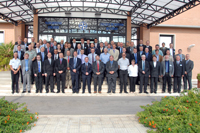
The NATO Defense College (NDC) is currently hosting this year’s Operation Research and Analysis Conference, organized by Allied Command Transformation (ACT) in collaboration with the Science and Technology Board. This yearly conference brings together the community of analysts from NATO Commands and Agencies, national defence research organizations, academia and industry.
Following on from the overarching theme of last year’s conference, “Leading the Way”, this year the leitmotiv is “Planning the Future”. With a focus on Strategic Foresight Analysis (SFA), presentations and discussion have been grouped into four topic streams: “Forecasting and Foresight”, “Analysis Methods”, “Capability Planning”, and “Operations”. On Friday 4 October, just before the closing plenary, participants will be divided into two working groups for in-depth discussion of analysis-related issues.
The NDC is honoured to host this high-level event, as evidenced by the College Director of Management (DoM) Cdre Harald HÅKONSEN (NOR N) in his welcome address.
The DoM led the audience through a brief presentation of the College’s history, starting from its origins in Gen Dwight D. EISENHOWER’s epoch-making statement of the need for a NATO Defense College. Focusing on the present day, the DoM spoke of the College’s three pillars – education, research and outreach; he complemented these remarks with information on the Courses offered and the overall objective of achieving consensus through human interoperability, which is accomplished in practice by placing a premium on Course Members’ committee work.
In his welcome address, the DoM dwelt on the Alliance-wide relevance of the Conference theme, “Planning the Future”. The constant fine-tuning of OR and analysis offers significant advantages, with regard not only to successful completion of NATO operations but also to maximizing the efficiency of day-to-day activities within NATO. In this respect, the DoM reminded the audience of times in the Alliance’s history when the turn of world events required rapid appraisal of developments which seemed not to have been factored into most forecasts – for example, the war in the Balkans, 9/11, the war in Afghanistan, or the Libya crisis. Actually, the extreme difficulty of foreseeing such events should come as no surprise; after all, as physicist Niels Bohr famously said, “Prediction is very difficult, especially when it is about the future.”
Thus, in addressing SFA, the Conference contributes to enhancing the knowledge and skills which are so important with a view to the time factor: the most difficult part of SFA may in fact not be threat assessment in itself, but the ability to ensure that this is achieved in a timely way.
It is for this reason, and in this spirit, that the DoM concluded his welcome address on a note of eager anticipation regarding the results of the discussion at the end of the week.
NDC Public Affairs Office
(Prepared by Ms Giulia Amparo Bruni Roccia, ITA C)

 NATO Defense College