
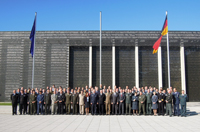
After beginning its European Perspectives Field Study in Rome with detailed briefings on Italian foreign, security and defence policies, Senior Course 123 (SC 123) travelled to Berlin.
On 1st October, the NDC delegation was welcomed to the Federal Ministry of Defence by State Secretary Mr Rüdiger Wolf, who spoke briefly about the value of cooperation between NATO and individual nations.
The national briefings began next morning, in the Stauffenberg Conference Room at the Federal Ministry of Defence. Here, the first speaker was Rear Admiral Thorsten Käler, Director General for Security and Defence Policy. After an initial overview of global security challenges, threats and risk, he explained the legal preconditions for Bundeswehr missions abroad within a framework of mutual collective security.
Rear Admiral Thomas Jugel, Deputy Director General for Strategy and Operations, then gave a detailed presentation of Germany’s commitment to the NATO, UN and EU operations. He also provided information on the prerequisites for Germany’s continuing contribution in Afghanistan after 2014. A busy
Q&A session with the morning’s speakers then brought this first session of the day to a close.
In the afternoon, Course Members attended further briefings at the Federal Academy for Security Policy. The NDC group was welcomed by the Academy’s Vice President, BrigGen (ret.) Armin Staigis, who gave an introductory presentation about the mission and tasks of the host institution.
The first speaker of the afternoon was Mr Robert Rohde, Deputy Director of the Defence and Security Policy Division at the Federal Foreign Office, who spoke about challenges and threats in the international environment. He emphasized two cardinal principles of German foreign policy: that no conflict can be solved by military means, and that security policy must be anchored on multilateralism.
Ms Christine Toetzke, Head of the Peace and Security Division at the Federal Ministry for Economic Cooperation and Development, then spoke about a specific aspect of German development policy: assistance to areas of the world particularly prone to conflict, violence and fragility. She stated that 1.5 million people live in “fragile” states, and that Germany spends more than 2 billion euros per year to assist those affected by the endemic problems associated with this fragility.
Finally, Dr Johannes Scheube, Head of the Fiscal Policy Division of the Federal Ministry of Finance, addressed Course Members on fiscal policy challenges in a German and European perspective.
A dynamic Q&A session with all three speakers brought the day’s proceedings to a close.
The next stop on the Field Study will be London.
NDC Public Affairs Office

 NATO Defense College


