
Senior Course 121 (SC 121) concluded its final Field Study with a visit to the Ministry of Defence and Joint Staff of Georgia, in Tbilisi, on 19th December. The group, led by NATO Defense College (NDC) Commandant Lieutenant General Arne Bård Dalhaug, attended a very instructive day of briefings and discussions.
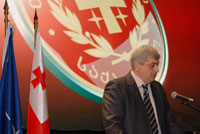
Course Members were welcomed by Mr Levan Dolidze, First Deputy Defence Minister, who placed Georgia’s progress towards NATO membership in a reasoned and balanced perspective: though the process requires time, the country is working hard to perfect its democratic acquis and comply fully with the standards that Alliance membership entails in areas such as institutional reform.
LtGen Dalhaug spoke about the excellent reciprocal arrangements between the Georgian authorities and the NDC, which has been particularly pleased to have Georgian representatives attending courses in Rome. Such contacts further enhance the good relations between NATO and Georgia, exemplified in the Georgian contingent’s significant contribution to the ISAF mission, and SC 121’s visit to Tbilisi highlights the interest on both sides in increasing cooperation.
The following speaker was Mr Nikiloz Vashakidze, Deputy Minister of Foreign Affairs. He offered an extensive overview of how Georgia’s increasingly international vocation is commensurate with the ongoing modernization and democratization of national institutions (both political and military) to meet NATO standards. Mr Vashakidze also gave an authoritative description of the three current priorities in Georgia’s foreign agenda: integration in the European and transatlantic security community, strategic cooperation with the United States of America, and peaceful coexistence and cooperation with its neighbours. The value Georgia places on territorial integrity and security is fully consistent with the importance it gives to the prospect of NATO membership and to active collaboration with the Alliance, even on particularly demanding missions: Georgian military personnel participating in ISAF have gained extremely valuable experience of an operative NATO environment and the specific standard procedures bound up in interoperability. Membership would thus not only elevate Georgian armed forces to the highest standards, but project stability and credibility more extensively in the Caucasus. Mr Vashakidze also spoke about dialogue and agreements with the European Union (EU) as a vital priority, before turning to Georgia’s good relations with Türkiye, Azerbaijan and Armenia: Azerbaijan, in particular, has become a strategic partner in the field of energy and related infrastructure.
Mr Dvid Dondua, First Deputy State Minister of Georgia for European and Euro-Atlantic Integration, was the next speaker. His presentation, entitled “Georgia’s way towards NATO”, reviewed significant milestones in NATO-Georgia relations: a founder member of the Partnership for Peace (PfP) in 1994, Georgia joined the Euro-Atlantic Partnership Council (EAPC) in 1997 and contributed to the Kosovo Force (KFOR) in 1999. Particularly significant was the explicit reference in the April 2008 Bucharest Declaration to the prospect of NATO membership for Georgia, followed by the setting up of the NATO-Georgia Commission in September of that year. Against this background, Mr Dondua explained the country’s massive ongoing reforms in considerable detail. In 2013, the North Atlantic Council will be visiting Tbilisi along with the NATO Military Committee, and the process of implementing a Membership Action Plan (MAP) will continue.
The morning session concluded with a panel lecture by Mr Dolidze, who focused specifically on Georgia’s defence sector reform, and Deputy Chief of Defence Major General Vakhtang Kapanadze, who gave a detailed update on how the reform process affects the Georgian armed forces. Defence budget planning, procurement, training and adaptation of national systems for purposes of interoperability were all analysed. On the last point, specific reference was made to the importance of in-field expertise gained alongside NATO contingents.
Field Study activities continued in the afternoon with a briefing by Mr William Lahue, Head of the NATO Liaison Office in Georgia, who offered a detailed perspective on the current political situation in the country, on NATO-Georgia relations, and on the role of the NATO Liaison Office in supporting the implementation of the MAP. Mr Lahue then left the floor to the final speaker of the day, Mr Alexander Rondeli, President of the Georgian Foundation of Strategic and International Studies. Mr Rondeli spoke about regional security in the Caucasus, the challenges and opportunities that this entails, and possible future scenarios.
All the day’s speakers were pleased to take questions from the audience. Both the morning and afternoon Q&A sessions were particularly appreciated by Course Members and speakers alike.
After the afternoon briefings, the day’s very full and impeccably organized agenda finished with a
press conferenceinvolving major national media outlets such as Info9, News.ge, Maestro, Rustavi2 and Tv9. Minister of Defence H.E. Irakli Alasania and Deputy Minister of Defence Mrs Tamar Karosanidze, who were interviewed at length, stressed a number of priorities: a correct perspective on military education, action to address current and emerging threats to national security, modernization of Georgia’s armed forces, and institutional reform. Minister Alasania also spoke of how education – and lessons learned from previous deployments – can contribute to security and stability, where possible with a view to avoiding remilitarization of the areas concerned.
The emphasis on education set the scene perfectly for LtGen Dalhaug’s concluding remarks, in which he was able to provide attending journalists with an overview of the NDC’s role in educating civilian and military personnel from NATO member states and partner countries.
See the Ministry of Defence of Georgia web site article about the visit.
More about the Field Study:

 NATO Defense College

