Skip to content
July 13, 2026
  • Facebook
  • X
  • LinkedIn
  • Youtube
  • Instagram
  • Flickr
NATO Defense College

NATO Defense College

Unitatem Alentes

NDC_103x103
  • Home
  • Courses
  • Publications
  • Jobs
  • NDC Foundation
  • FAQs
  • Education mail
Primary Menu
  • Home
  • Organization
    • About Us
      • Mission
      • Who’s Who?
      • Structure
      • History
      • Vox Collegii Magazine
    • News
    • Resources & Services
      • Library
      • Facilities
      • Links
      • Vision Link
      • FAQS
    • Opportunities
      • Job Opportunities
      • Procurement
    • Contact & Information
      • Contacts, maps, visits
      • Follow us
      • Disclaimer
  • Education
    • General Information
      • On-site Courses
      • e-Learning
      • Academic Calendars
      • Study Projects
    • Long Courses
      • Senior Course
      • NATO Regional Cooperation course (NRCC)
    • Short Courses
      • Generals, Flag Officers & Ambassadors’ Course (GFOAC)
      • Generals, Flag Officers and Ambassadors’ Course for Partners, GFOAC-P (former SERC)
      • Modular Short Courses (MSCS)
      • Modular Short Course Partners Integrated (MSC-PI)
    • Partnerships
      • NDC Leicester Partnership
      • NDC LUISS Partnership
      • NDC Simon Fraser Partnership
    • Administration
      • Members’ Administration Section (MAS)
  • Research
    • About Research Division
    • Researchers
    • Publications
    • Opportunities
    • NATO NextGen Futures
  • Engagement
    • Conference of Commandants
    • International Week in Kyiv
    • Anciens’ Seminar
    • Other Engagement
  • Portals
    • Academic Portal
    • NDC Anciens’ Association
    • Academic Advisory Board
    • NRCC Academic Advisory Board
    • Conference of Commandants
  • Newsletter
    • Vox Collegii Newsletter
  • en_USEnglish
    • fr_FRFrançais
  • Home
  • News
  • Interview with Admiral Giuseppe Cavo Dragone
  • Editor's Pick
  • News

Interview with Admiral Giuseppe Cavo Dragone

Published: February 10, 2026 | Updated: February 18, 2026 4 minutes read

Admiral Giuseppe Cavo Dragone made his first official visit to the NATO Defense College (NDC) as Chair of the NATO Military Committee on 4 and 5 December 2025. Chairing the 55th Academic Advisory Board, Admiral Cavo Dragone took a moment to discuss the vital role the College plays in shaping NATO’s future. In this interview, he explores how strategic education contributes to the Alliance’s readiness and cohesion.
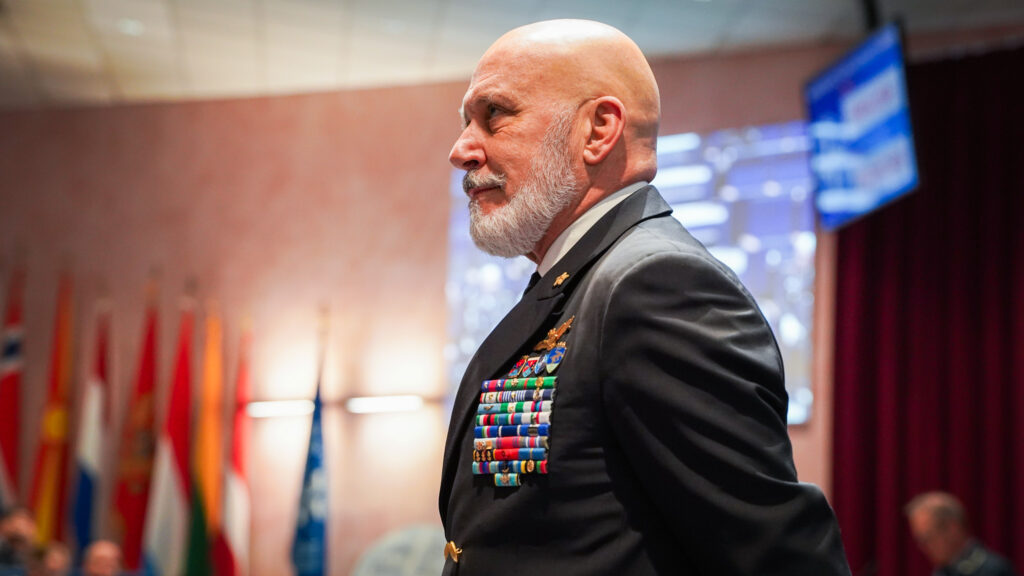
Admiral Giuseppe Cavo Dragone, Chair of the NATO Military Committee

Why is strategic education critical to NATO’s mission?

Since its founding, NATO has recognized that education is not just another activity, that it sits at the heart of the Alliance’s collective strength and shared purpose. Over the years, NATO’s education and training efforts and initiatives have expanded, both geographically and institutionally, and have evolved to meet the needs of a dynamic and increasingly complex security environment. The spearhead of this commitment is the NDC, as the Alliance’s premier academic institution, fostering strategic thinking and forward-looking research, and cultivating the bonds that underpin NATO’s unity.

Strategic education is critical to NATO’s mission because it strengthens the foundation of what we call “the collective”. By embedding shared values, mutual understanding and trust among Allies, education ensures that NATO leaders are prepared to handle the most pressing challenges and can work seamlessly as one in times of crisis. Having had experience of training and education at different levels during my career, I can attest that these efforts foster the strategic foresight, cohesion and clarity needed to deliver timely and effective military advice. It is through education that NATO consolidates its common vision and prepares leaders to act decisively and collaboratively, ensuring the Alliance remains resilient and adaptable in an ever-changing world.

As the Chair of the NATO Military Committee, what in your view are the main skills required from the Alliance’s next generation of leaders?

I believe that leadership is not innate, that it can be learned and trained. In this sense, true leaders will have themselves been “good” followers in the past, and shown an ability to identify good leadership and improve their own skills over time. Looking ahead, the Alliance needs leaders who can maintain a “bird’s eye” view, connecting strategic objectives with tactical actions, with calculated consequences; leaders who will not be afraid of taking hard decisions under strong pressure, even without much information. The next generation of leaders will have to cultivate the collective. This means uniting Allies with different approaches, cultures and histories, while promoting a burden-sharing mindset and the readiness to sacrifice for the common good. Only leaders who are able to build a shared vision will manage to address our common and future challenges. And to that end, leaders have to truly believe in the values and principles they fight for. Leadership can be laden with responsibility, solitude and risk. But it is also the highest service one can give – not to oneself, but to others.

As President of the NDC’s Academic Advisory Board (AAB), which specific element of the NDC’s curriculum or teaching methodology do you regard as meriting further strengthening at this point in time, in order to ensure our future leaders are adequately equipped for the evolving security and technological landscape?

I can certainly say that we’re living in a time where the pace of change – technological and security-related – is overwhelming. The next generation of leaders needs to be prepared not just to keep up with new scenarios – in a reactive way – but also to anticipate and stay ahead of the curve. I believe one of the greatest opportunities for strengthening this academic path lies in how we integrate cutting-edge technologies, such as artificial intelligence, quantum computing and autonomous systems, in the way we teach.

It is not just about learning how these tools work; it is about preparing leaders to make fast, complex decisions in high-pressure situations, while also grappling with the ethical questions surrounding these advancements. It is critical that we embed this technological focus directly into our leadership training, thus connecting innovation with decision-making, strategy and values.

And at the heart of it all, we cannot forget the human element. Technology is powerful, but it must remain a tool that serves our objectives – it should never replace them. I would like to see our curriculum take an even stronger stance on that connection, blending technical expertise with the kind of “people first” leadership that will ensure our future leaders don’t just adapt to change, but shape it in ways that benefit us all.

NDC Public Affairs Office


Post navigation

Previous: A new face of war – Russian military strategy post-Ukraine
Next: The NDC Inaugurates Senior Course 148 and NATO Regional Cooperation Course 35

CLOUD TAGS

NATO East Europe and Russia Strategy Middle East/North Africa Future Asia/Pacific Hindsight War

PUBLICATIONS BY REGION

  • NATO
  • Middle East/North Africa
  • Asia/Pacific
  • East Europe and Russia

PUBLICATIONS BY TOPICS

  • The War Series
  • The Strategy Series
  • The Future Series
  • The Hindsight Series

RESEARCH

  • About Research Division
  • Researchers
  • Publications
  • Opportunities
  • NATO NexGen Futures

Recent Posts

Video: The Mind as a Battlespace: Reshaping Education, Resilience and Decision-Making Video interview: CoC 2026
  • Editor's Pick
  • News

Video: The Mind as a Battlespace: Reshaping Education, Resilience and Decision-Making

July 7, 2026
Betting on blue: how to improve NATO military forecasting for acquisitions Outlook 07 2026
  • News
  • Publications
  • The War Series

Betting on blue: how to improve NATO military forecasting for acquisitions

July 6, 2026
Building Consensus: Senior Course 148 Simulates NATO Crisis Decision-Making Senior Course 148 participant discussing during the Negotiation, Mediation and Decision-making Exercise
  • Courses
  • News

Building Consensus: Senior Course 148 Simulates NATO Crisis Decision-Making

June 26, 2026
Field Study 3: Deterrence, Collective Defence & Resilience on NATO’s Eastern & Northern Flanks SC 148 delegation in Vilnius
  • Courses
  • News

Field Study 3: Deterrence, Collective Defence & Resilience on NATO’s Eastern & Northern Flanks

June 25, 2026
The Human Mind as a Battlespace: Insights from the Conference of Commandants 2026 NDC Commandant LGEN Max A.L.T. Nielsen delivering his welcome address during the 2026 Conference of Commandants.
  • Conference
  • News

The Human Mind as a Battlespace: Insights from the Conference of Commandants 2026

June 24, 2026
The NDC Conducts its 2027 Field Study Planning Conference Field Study Conference participants during a briefing
  • Conference
  • News

The NDC Conducts its 2027 Field Study Planning Conference

June 23, 2026

CONTACT US

Central Registry
NATO Defense College
Via Giorgio Pelosi 1, 00143, Rome - Italy
E-mail: [email protected]

You may have missed

Video interview: CoC 2026
1 minute read
  • Editor's Pick
  • News

Video: The Mind as a Battlespace: Reshaping Education, Resilience and Decision-Making

July 7, 2026
Outlook 07 2026
1 minute read
  • News
  • Publications
  • The War Series

Betting on blue: how to improve NATO military forecasting for acquisitions

July 6, 2026
Senior Course 148 participant discussing during the Negotiation, Mediation and Decision-making Exercise
5 minutes read
  • Courses
  • News

Building Consensus: Senior Course 148 Simulates NATO Crisis Decision-Making

June 26, 2026
SC 148 delegation in Vilnius
5 minutes read
  • Courses
  • News

Field Study 3: Deterrence, Collective Defence & Resilience on NATO’s Eastern & Northern Flanks

June 25, 2026
Central Registry
NATO Defense College
Via Giorgio Pelosi 1, 00143, Rome - Italy
Telephone: (+39) 06 50525 309 / 275
Fax: (+39) 06 50525 799
[email protected]
Public Information/media related matters:
[email protected]
Web related matters:
[email protected]
US Postal Address
U.S. National Support Element
NATO Defense College
PSC 802 BOX 201
FPO AE 09608-0003

UK Postal Address
Name Rank Number
Dept
NATO Defense College
BFPO 65

RELEVANT LINKS

NATO HQ
SHAPE
NATO ACT
NATO School
NATO Defense College Foundation
  • Organization
  • Education
  • Research
  • Engagement
  • Portals
  • Facebook
  • X
  • LinkedIn
  • Youtube
  • Instagram
  • Flickr
NATO Defense College © 2026 All rights reserved.
NATO Defense College NATO Defense College
Welcome back
Sign In
Sign in to access your downloads, manage your account, and continue where you left off.
Login Account
Enter your credentials to access your account
Forgot Password?
We use cookies to ensure that we give you the best experience on our website. If you continue to use this site we will assume that you are happy with it.