
On 20 April 2023, Senior Course 142 flew from Norfolk to New York for the last stop of their Field Study 2 programme in the United States. Course Members visited the United Nations Headquarters (UNHQ) and the Permanent Mission of Germany to the United Nations.
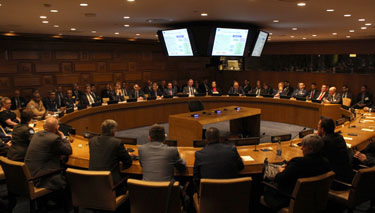
On the day of arrival, the NATO Defense College (NDC) delegation, led by the Commandant, Lieutenant General Olivier Rittimann, attended a presentation at UNHQ delivered by Major General Maureen P’ Obrien, Deputy Military Advisor, Office of Military Affairs of Department of Peace Operations.
Major General Maureen P’ Obrien presented a briefing on the work, main tasks and responsibilities conducted by the Office of Military Affairs (OMA), which works to deploy the most suitable and effective military capabilities in UN peacekeeping missions. General P’ Obrien introduced the structure of the OMA and was also accompanied by colleagues who explained the key tasks of their respective services and teams. The OMA is composed of the Office of the Military Advisor, the Force Generation Service, the Military Planning Service, the Current Military Operations Service, Assessment Team, Policy and Doctrine Team, and the Military Performance Evaluation Team.
Major General P’ Obrien addressed the current peacekeeping challenges from the military perspective and the future of peacekeeping. The presentation was followed by a Q&A session and a gift exchange between Lieutenant General Rittimann and Major General P’ Obrien. The visit concluded with a tour through the UNHQ premises.
On the following day, Course Members visited the Permanent Mission of Germany to the United Nations. Upon arrival, they were welcomed by Ambassador Michal Miarka who reviewed NATO’s current priorities and refocus on collective defence.
He then gave the floor to the Permanent Representative of Albania to the UN, Ambassador Ferit Hoxha, who delivered insights on the Security Council. He first talked about the Council’s reaction to the Russian invasion of Ukraine, stressing the need to combat misinformation and to maintain a clear and coherent narrative amongst all Member States. He also explained how Council is facing limitations and challenges such as the lack of empathy and commitment from the global south due to the climate and food crisis. Nevertheless, he added, “one of the best lessons we can draw out of this crisis” is the fantastic mobilisation of countries to provide support to Ukraine, and a stronger and more unified Alliance.
Afterwards, Course Members had the opportunity to attend a panel discussion with Military Advisors of NATO members (France, United States and United Kingdom) on the challenges of UN Peacekeeping, followed by a Q&A session.
The day concluded with a briefing from Ambassador Thomas Zahneisen, Deputy Permanent Representative of the Permanent Mission of Germany. He reflected on Germany’s foreign policy regarding the UN, stressing that Germany has always been a strong contributor to the UN. He also talked about some of the challenges the UN is facing (division between western countries and Russia; the changing Chinese commitment in previous years; expectations from the “Global South” vis-à-vis the western countries) and highlighted the UN’s efforts to engage a more intense dialogue to address the needs in the south. Despite the challenges the UN is facing, he underlined, it is still “the most efficient multilateral system that complies with international rules” to address global threats. The presentation was followed by a Q&A session.
New York marked the last stop in the United States for Field Study 2 for SC 142. Reflecting on this Field Study focused on the transatlantic link, Course Members Colonel Dumitru Todosiuc, from the Romanian Armed Forces, and Lieutenant Colonel Salvatore Mottola, from the Italian Guardia di Finanza, lauded the programme for providing a unique opportunity to visit a few of the American and NATO Headquarters located in Washington D.C. and Norfolk, as well as the UNHQ in New York. They appreciated the shared knowledge and openness from the speakers and highlighted that having discussions with the military and political representatives helped them better understand the dynamics between the US political and military fields.
NDC Public Affairs Office
(Prepared by Ms Sofia Carvalheiro, PRT C)
 NATO Defense College