
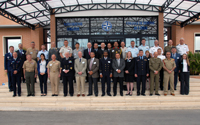
The NATO Defense College’s Generals, Flag Officers and Ambassadors’ Course (GFOAC), ran from 2-6 May in Rome. Thirty-two course members from 20 different nations participated in the first of two GFOAC’s to be held this year. Nations from NATO, the Mediterranean Dialogue (MD), Istanbul Cooperation Initiative (ICI), and the Partnership for Peace were represented along with Iraq and South Korea. For the first time, the World Food Programme also had a representative attending the course.
The theme for GFOAC 2011-1 was “NATO in an Era of Active Engagement and Modern Defence.” The course kicked-off with a presentation by Dr. Karl-Heinz Kamp, Director of the NATO Defense College’s Research Division. He gave a presentation on NATO’s Nuclear Issues including a look at deterrence and threats. In a wide-ranging series of lectures, the course members also heard presentations about the Transatlantic Link, NATO and the Middle East and North Africa, NATO and Russia, Globalisation and the Impact on Defense and Security Policy, Afghanistan and Pakistan as a Strategic Crossroad, and the Future Character of Warfare. The academic portion of the course finished on Friday, with an excellent lecture by Dr. James Boutilier on the Strategic Implications of China’s Rise to Power.
Another highlight of the course was two Video Teleconferences (VTC) held with senior ISAF leadership. The first VTC was with NATO’s Senior Civilian Representative to Afghanistan, Ambassador Simon Gass. Ambassador Gass provided detailed insight into the comprehensive approach NATO is taking towards Afghanistan. The second VTC was with the ISAF Commander, General David Petraeus. Both General Petraeus and Ambassador Gass gave candid and forthright presentations of the challenges and progress resident in the NATO effort in Afghanistan. At the end of each presentation the two senior leaders fielded questions from the course members.
The next GFOAC is tentatively scheduled for 6-14 December 2011 in Rome and Brussels.
NDC Public Affairs Office


 NATO Defense College