
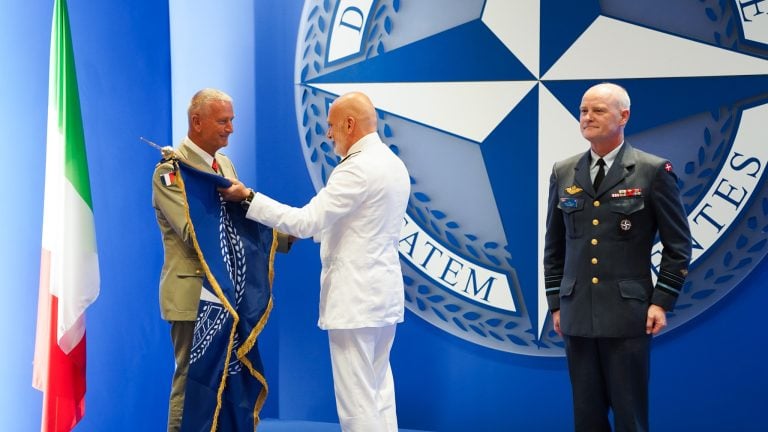
The Inauguration Ceremony for Senior Course 114 was held today, 27 February, at the NATO Defense College.
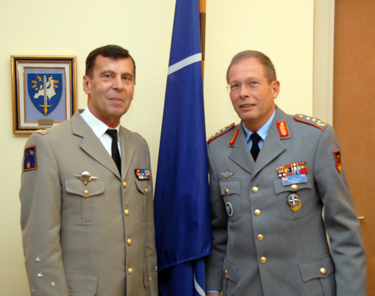
General Henri Bentegeat, Chairman of the European Union Military Committee, was the guest of honour.
Lieutenant General Wolf-Dieter Loeser, Commandant of the College, welcomed Senior Course members and their families, along with a large number of distinguished visitors, ambassadors, defence attaches and high-ranking officials.
He pointed out that there are 92 participants in SC 114: a record total for the NDC. These Course Members, coming from 39 nations, include representatives not only of NATO nations, but also the Partnership for Peace (PFP), the Mediterranean Dialogue, the Istanbul Cooperation Initiative, Iraq and Contact Countries and – for the first time – representatives of Korea and Bosnia-Herzegovina.
General Loeser emphasized the difficult challenges but also the tremendous opportunities now facing the Alliance: Kosovo, Afghanistan, Russia, the new US administration and the NATO 60 th anniversary celebrations this coming April, during which two more nations, Albania and Croatia, will join the Alliance.
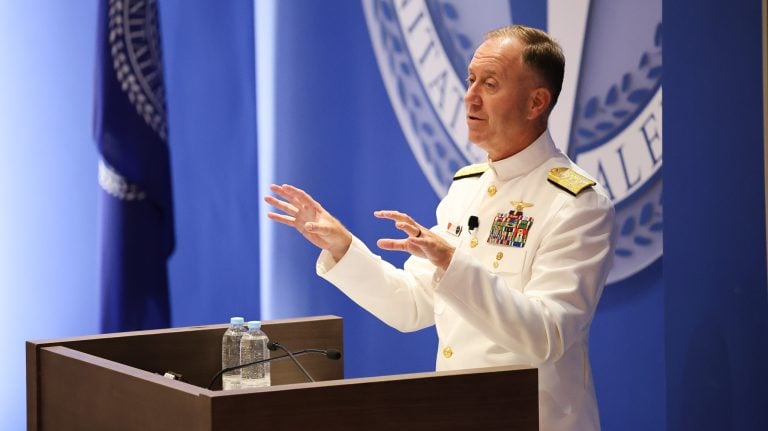
General Bentegeat’s lecture ( “click” here for full version) focused on the complementarity of NATO and the EU in the military domain; the urgent need to strengthen dialogue and co-ordination between the two organizations; and their differences in nature and approach to crisis management.
The European Union is a community of nations: a political and civilian entity with a small military structure in comparison with that of NATO. The EU seeks to implement civilian, financial and even military means, though not necessarily by using force. Beyond this, freedom, democracy and respect for human rights are shared values of the two organizations. Stronger joint efforts must be made to ensure peace and international stability: in order to achieve this goal, dialogue between the two organizations is fundamental.
The EU contribution to NATO can provide greater flexibility by offering fresh solutions to crisis management and stronger support to the military structure.
The United States will remain a benchmark in military, financial and technological domains, so a stronger link with the EU is vital. This is even more important if we consider two of the major challenges of the next decades, natural resources management and migration. In order to face these challenges, it is essential to reform and renew not only multilateralism but, most importantly, the alliance between the EU and NATO.
Prepared by Ms Teresa Caterino (ITA)
 NATO Defense College