

On Monday 24 October 2009, Senior Course 115 visited the Allied Command Transformation (ACT) Headquarters in Norfolk, Virginia, for a series of high-level briefings and discussions. The purpose of the Norfolk visit was to receive firsthand information on strategic issues and the military strategic projects initiated and overseen by the professionals at ACT. The one-day programme for SC 115 provided an in-depth presentation on ACT’s support to NATO missions and military operations, on the Joint Analysis Lessons Learned Center and its role, and on the ongoing Multiple Futures Project, giving Course Members a deeper understanding of the key issues that ACT is currently tackling.
The welcome remarks by ADM Luciano Zappata, Deputy Supreme Allied Commander Transformation, were the start of a day of very interesting presentations and lively discussions on the new security challenges that have set the Alliance on an inevitable course towards transformation. The various topics covered included ACT Command Policy, NATO’s New Strategic Concept, the Multiple Futures Project, Transformation, Interoperability, and Future Capabilities.
CDR Tony Deaville, USN, presenting the first briefing, gave an overview of ACT and its strategic vision, emphasizing that ACT was NATO’s “forcing agent for change.” This led to an interesting discussion on the general topic of “transformation”, with a look at NATO’s past, present and future and the reasons behind the need for transforming. He concluded by outlining ACT’s goals and priorities and the key challenges it has to face, and the ongoing process of facilitating, advocating and enhancing Alliance capabilities.
BGEN Hansen-Nord followed with an excellent and informative briefing from the Joint Analysis and Lessons Learned Center, which explained the Lisbon Command’s responsibilities and discussed current initiatives and challenges. He stressed the importance, especially for the ISAF mission, of performing joint analysis of operations, training and exercises.
CDR Richard Perks, CANN, Multiple Futures Project Team, gave a very detailed briefing and overview on the Multiple Futures Project. The MFP lists a number of security scenarios that are likely to arise in the future, so that the Alliance can better plan the use of its forces and capabilities to meet future challenges. The Project establishes common ground for strategic dialogue on the risks and vulnerabilities that could endanger Alliance populations, territorial integrity, values and ideas. CDR Perks emphasized the importance, in this regard, of supporting the Strategic Concept development process. The Focus Areas described in the MFP (which are now available to the public) serve as catalysts to drive policy change, inform defence planning and assist in prioritizing capability development. During the Q&A session, Senior Course Members discussed current developments in the new NATO Command Structure and the Future NRF Structure, the NATO-EU relationship, and other relevant topics.
MGen Kjell-Ove Skare, ACT Assistant Chief of Staff, IMP, NOR A, moderated a Flag Officers’ panel, which raised the discussions held during the day to an even higher level. During a robust question and answer period, the panel, consisting of RADM Raditsas, RADM Canova, MGEN Willemse, BGEN Demaria, BGEN Hansen-Nord, BGEN Cinek and BGEN Pedersen, engaged in a strategic-level exchange of frank and open-minded ideas.
The visit to the Allied Command Transformation Headquarters added great value to SC 115’s security policy education on the demanding responsibilities that ACT will have in the future development of the Alliance. In his closing remarks, Lieutenant General LOESER, Commandant of the NDC, said that the cooperation between ACT and the NDC had been most productive and thanked our hosts on behalf of all NDC participants.
As another highlight of the day, following the academic part of the visit to Norfolk, the Course enjoyed a very interesting tour of a US aircraft carrier, the USS Harry S. Truman (CVN 75) , hosted by Commanding Officer Captain Joe Clarkson. They learned of the Carrier’s history, received capability briefings, and participated in a discussion on a range of issues of concern to them. The visit was also an excellent opportunity to meet and interact with many of the ship’s company.
On 28 October 2009 Senior Course 115 arrived in Ottawa, where they were warmly welcomed by the Host Nation Representatives. The next day a series of highly informative briefings were presented on Canada’s role in international security, the Canadian armed forces, defence strategy and other highly important issues.
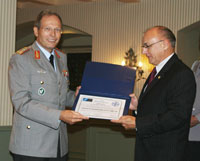
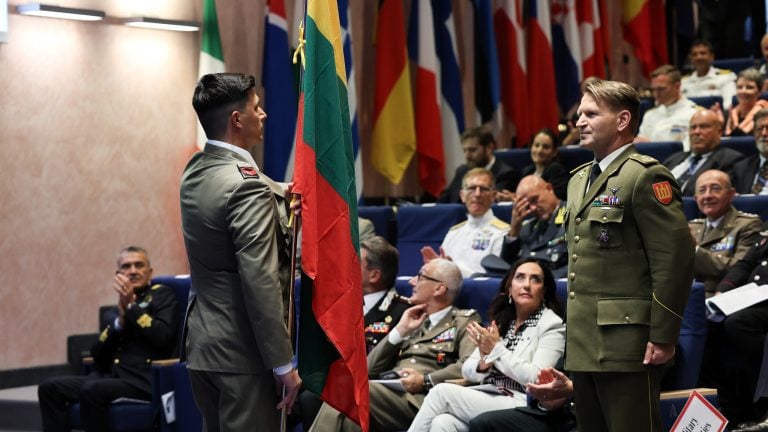
The Commandant of the NATO Defense College (NDC), LTG. Wolf Dieter LOESER, bestowed the important title of Honorary Ancien of the College on Gen (Ret) Ray HENAULT, former Chairman of the NATO Military Committee, in recognition of his tireless and outstanding support for NDC activities. The ceremony was one of the high spots of a day devoted to in-depth presentations by Canadian experts on various selected matters.
A warm welcome address on behalf of GEN Walter J. NATYNCZYK, CMM, MSC, CD, Chief of Defence Staff, was given by VADM D. Rouleau, Vice Chief of Defence Staff, who emphasized the importance of the NDC visit.
The first presentation was delivered by Mr Donald SINCLAIR, Director General International Security, Department of Foreign Affairs and International Trade, who pointed out that the changed security environment is stretching the definition of security as well as that of defence. Energy security is a new challenge to be faced in addition to existing ones. Another future concern is Arctic security. In the complex context of contemporary global security, the Transatlantic Link and Canada’s ongoing ties to Europe continue to be important. He emphasized the Canadian public’s continuous support for the Canadian military, an institution that plays a significant role in forging the nation’s identity. Mr Sinclair’s presentation was followed by a very interesting discussion on a range of important security issues.
The second speaker, Rear Admiral Robert DAVIDSON, gave a presentation in his capacity as Director of Staff, Strategic Joint Staff at the National Defence Headquarters, on "The Canadian Forces Mission, Priorities and Transformation". His definition of the meaning of transformation for Canadian military forces was greatly appreciated by the audience. All Canada’s government branches are involved in the “Comprehensive Approach”, which encompasses not only military forces but also the civilian structures taking part in nation-building projects in missions abroad, the most important of these being the mission in Afghanistan. During the Q&A session that followed, Senior Course Members engaged in a lively discussion with the speaker.
The last speaker of the day was Dr Michael MORGOLIAN, Director General Policy Planning of the Department of National Defence. In his presentation on "The Canada First Defence Strategy", he discussed the recapitalization of Canadian military capabilities and touched on issues such as cyber warfare, the influence of changing security threats, climate change in the Arctic, and the importance of interagency and multilateral cooperation. His presentation was followed by an intensive question and answer session.
The late afternoon session was entirely devoted to one lecture, given by LTG (Ret.) The Honourable Roméo Antonius DALLAIRE , Senator, who is widely known for having served as Force Commander of the United Nations Assistance Mission for Rwanda ( UNAMIR) from 1993 to 1994, and for his efforts to stop the genocide perpetrated by Hutu extremists against Tutsis and Hutu moderates. LTG Dallaire is a Senior Fellow at the Montreal Institute for Genocide and Human Rights Studies (MIGS) and Co-Director of the MIGS Will to Intervene (W2I), a project that recently released a policy recommendations report, "Mobilizing the Will to Intervene: Leadership and Action to Prevent Mass Atrocities." LTG Dallaire has spent much of the last decade and a half reminding the world not to let the same thing happen again. His presentation, “When Humans Don’t Seem to Count”, focused around one main question: “How to prevent genocide in the 21st century?” He examined the role of conflict prevention, resolution and responsibility to humanity. In this new era, he said, we need to go back to our drawing board and rethink our concepts and policies. For the Senior Course this was a highly inspirational presentation, a fact reflected in the discussion that ended the valuable session with LTG Dellaire, whose address was an appropriate conclusion to a remarkable and substantial visit.
The Field Study in Canada ended with a visit to the Canadian Space Agency, the Bell Helicopter Factory and an L3 Communications Tour in Montreal. Teams of highly qualified professionals provided interesting presentations of their agencies and tours of their premises.
The Ottawa visit concluded the eleven-day stay in North America, comprising stops at the United Nations Headquarters in New York City, briefings from multiple government agencies in the U.S. capital of Washington, DC, and a stay in Norfolk, Virginia for a series of briefings at Allied Command Transformation.
In accordance with tradition, the College will be back in Ottawa within the next 18 months.
NDC Public Affairs Office
(Prepared by Col. Daria DANIELS SKODNIK, SVN)
 NATO Defense College