
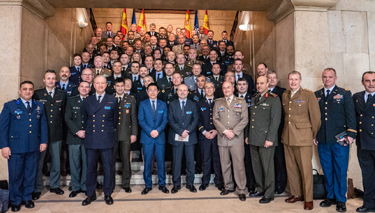
Headed by the Dean, Dr Stephen Mariano, Senior Course 134 and participating faculty of the NATO Defense College visited Madrid on 25 and 26 March, as part of the first Europe-an Field Study.
The delegation was warmly welcomed at the Spanish Centre for National Defence Studies (CESEDEN) by its Deputy Director, Vice Admiral Gonzalez Rodriguez, who briefly mentioned the democratic, but not always easy transition that Spanish society underwent in recent history. Subsequently, the moderator of the day, Colonel Ignacio Fuente Cobo, Faculty Adviser and Spanish Senior National Representative at the NDC, explained the domestic and international roles and functions of the CESEDEN.
Ambassador Jorge Hevia Sierra delivered the first briefing on ‘Spain’s Foreign Poli-cy’ giving a valuable overview of the many emerging risks and threats to international global governance: the rise of China, nationalism, less respect for international law, fundamentalism and terrorism, driving middle-sized countries like Spain to actively work in favour of multilateralism and common, global policies. Additionally, Spain’s strategic position makes it an important actor in building good bilateral, and European relations with the Magreb countries, in particular Morocco and Algeria. The Director of the Office of the Under Secretary of State for Political Affairs, Major General José Luis Figuero gave details, in his presentation, on ‘Spanish Defence Policy’: its background; legal framework; organization; and lines of action, in the face of global, multifaceted threats and challenges. He described key documents including the 2015 National Security Act followed by the National Security Strategy 2017, ‘a shared project by all and for all’; the ‘Collaborative Framework with the US’ and the 2016 ‘EU Global Strategy’. Some 2.800 personnel are seconded within predominantly EU, NATO and UN missions, which underline Spain’s strong support for multilateralism. He attached great importance to increased European defence cooperation including capability development within the Permanent Structured Cooperation (PESCO) framework, as a valuable add-on to a contemporary, European industry base without undermining NATO.
The Head of the Planning Division of the Spanish Joint Defence Staff, Rear Admiral Be-nigno Gonzalez-Aller Gros briefed on ‘the Spanish Defence Planning Process’. He described defence planning as a sum of the assessment of needed military capabilities and available resources, all based on strategic documents providing political guidance. Thereafter, he provided an overview of the organizational and legal framework of the Spanish six year cycle.
In the evening, the Spanish Chief of Defence, and an Ancien of Senior Course 108, General Fernando Alejandre Martínez, hosted a reception, to which a number of other Spanish Anciens were present, showing Spain’s keen interest in, and contribution to the NDC.
The next day, Mr Carlos Burgos of the Under-directorate for Inspection, Regulation and Industrial Strategy (INREID) – DGAM in the Ministry of Defence, briefed on the ‘Spanish Defence Industry’, giving details on its programmes and main challenges. At Retamares Joint Base, a short bus ride outside Madrid, Chief of Staff of the Joint Operations Centre, Major General Francisco Braco Carbo welcomed the NDC delegation. Subsequently, the Commander of the Spanish Joint Operations Command (MOPS), Lieutenant General Fer-nando López del Pozo welcomed the group and initiated the briefings by handing over to Commander Ovidio Garcia who briefed on MOPS and the current operations within na-tional, UN, EU, and other multilateral and national frameworks. He gave a clear picture of Spain’s international military engagements, and described Spain’s involvement in stabilization and security operations, operations against terrorism, deterrence and defence operations, which all underline the Spanish commitment to Collective Security and International Solidarity. Rounding off the briefings, Major Oscar Corbacho and Captain (Navy) Enrique Cubeiro answered questions on the 24/7 Spanish Joint Cyber Defence Command, focusing on its defence, exploitation and response tasks.
The NATO Defense College participants gained much from the comprehensive, inter-ministerial briefings that underlined Spain’s important role in NATO and the EU. Additionally, they highly appreciated the warm welcome and hospitality received during the two spring days in Madrid.
NDC Public Affairs Office

 NATO Defense College