
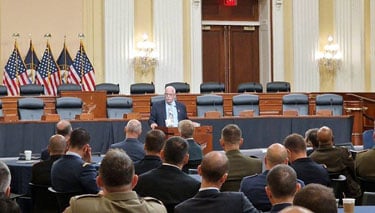
Washington, D.C. was the final destination for Senior Course’s Field Study I. On 4 October 2023, Senior Course 143 (SC 143) was hosted at Capitol Hill for a morning of briefings. The delegation then paid their respects at Arlington Cemetery where the Commandant of the NATO Defense College, Lieutenant General Max A.L.T. Nielsen, participated in a wreath-laying ceremony at the Tomb of the Unknown Soldier. The following day, SC 143 visited the Pentagon for a series of in-depth presentations that afforded Course Members special insight and knowledge about U.S. security and defence policy. A special reception, hosted by Air Force Vice-Chief of Staff, General David W. Allvin, officially concluded the first Field Study of SC 143.
Upon arrival at the Rayburn Building, LGEN Max Nielsen, the NDC’s Commandant, introduced the delegation to Congressman Gerald Connolly, member of the U.S. House of Representatives and former President of the NATO Parliamentary Assembly from 2020 to 2022. Congressman Connolly provided an overview of the current political landscape in the U.S.; explained how Congress works; offered commentary on the Russian aggression in Ukraine; spoke of U.S.—NATO relations and cooperation; and the various views regarding China. For Congressman Connolly, the Alliance is composed of countries that share the same democratic values; therefore, one of NATO’s main tasks is to also defend those principles. Democracy is fragile, and men and women in uniform have the responsibility to protect our freedom and values, he stated. Congressman Connolly then provided highly detailed and thorough answers to Course Members’ questions on U.S. support to Ukraine; the challenge of China and Taiwan; expectations of the next NATO Summit in Washington in July 2024; how the U.S. and NATO can support fragile democracies.
The following briefer was COL Gary Rafnson of the U.S. Air Force, from the Office of the Chief, Legislative Liaison (OCLL ). After describing his duties, COL Rafnson briefed the Senior Course on how the U.S. Air Force and Congress interacts with one another, highlighting the importance of creating shared understanding between the U.S. Armed Forces and members of the House of Representatives. Responsibilities include responding to Congressional inquiries and ensuring that the Armed Forces have the appropriate level of authority and are sufficiently resourced. He also spoke of the legislative process and the role of the various committees in Congress, prior to starting the Q&A session during which Course Members addressed questions on the Legislative Office’s portfolio.
After lunch, the NDC delegation attended a wreath-laying ceremony at the Tomb of the Unknown Soldier at Arlington National Cemetery. LGEN Nielsen and Ms Ozlem Sayin, Vice-President of Senior Course 143, led the commemorative service, in a show of respect and deference to the host nation.
On the second day, SC 143 visited the Pentagon where Lieutenant General Kevin B. Schneider, Director of Staff, Headquarters Air Force, congratulated Course Members for having been selected to the Course, emphasizing how the relationships formed in such an international environment should never be underestimated. He also spoke of the power of teamwork and how relationships are key to determining the future. Later on, LGEN Schneider answered Course Members’ questions on support to Ukraine; the Indo-Pacific; the Sahel and Mediterranean regions, and American priorities in those areas.
SC 143 then heard from Mr Spencer P. Boyer, Deputy Assistant Secretary of Defense for European and NATO Policy, and Mr Matthew Wall, Acting Director Office of Regional Security and Political Military Affairs, U.S. State Department. The panellists described tasks performed by their respective offices; the Russian invasion of Ukraine; U.S. support to Ukraine, and the most recent NATO Summit in Vilnius. They also stressed the importance of improving Readiness of Forces and investments in defence, technology and research to increase innovation and capability. The speakers addressed how sanctions are affecting the Russian economy, as well as about China, whose continued investments in infrastructure in Europe pose possible security risks on. The two speakers spoke of the next NATO Summit in Washington, and Sweden’s accession to NATO. During the Q&A session, Course Members sought to learn more on recent rising tensions in Kosovo; U.S. support to Ukraine; plans to increase investments in diplomacy and cooperation; and China as a challenge for the United States.
The final briefer was COL Abizer Tyabji, Chief Europe/NATO Division – Deputy Under Secretary of the Air Force, International Affairs, who delivered a presentation on security cooperation. COL Tyabji stressed the importance of security cooperation and relationships to face global security challenges, including strategic competition and violent terrorists. Cooperation activities include training, education, exercises, personnel exchanges, agreements, armament cooperation, among many others. “We cooperate with over 100 partner nations across the capacity spectrum, and in all areas of responsibilities,” concluded the briefer.
In the evening, Vice-Chief of Air Force Staff General David W. Allvin hosted a most remarkable reception that capped off a truly memorable Field Study to the United States of America.
NDC Public Affairs Office
 NATO Defense College