
In the week after their return from the “TRANSATLANTIC LINK” Field Study, Senior Course 114 completed the 13th week of the academic programme with Study Period (SP) C1, focusing on “Global Security Challenges”. The aim of the SP is to analyze the global issues and new security risks facing the Alliance. The ten-week NRCC Course (NATO Regional Cooperation Course) with Course Members from ICI, Med-Dialogue and NATO countries was also part of the April activities of this Study Period. The purpose of this challenging Study Period was to provide the Course Members with a sound basis of selected political, economic, military and also scientific topics of strategic relevance. The objective was to further improve their understanding of the changing security environment and the related implications for global security in general and for NATO in particular. However, most of the security issues addressed in this study period were of a non-military nature. All these topics affect the various nations and the Alliance’s security and are closely interconnected.
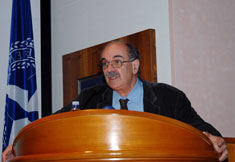
“National Identity and Pluralism” was the first lecture topic on Monday, April 20th, 2009, presented by Professor Michel Wieviorka (France), Director of the Centre for High Level Studies on Social Sciences (PARIS). He delivered a very convincing presentation, analyzing concepts and phenomena related to the development and status of national identity and the effects of pluralism on modern societies.
On Tuesday morning, April 21st, the intertwined issues of “The Environment and Consequences of Climate Change” and “Energy Security” were presented. The lecture on “The Environment” was delivered by Eija-Riitta Anneli Korhola (Finland), Member of the European Parliament (MEP). Mrs Korhola offered a well received description of the relevant aspects of environmental topics and their effects on climate change which might have an impact in many respects on future strategic issues. The Course Members also benefited from the rich parliamentarian experience of the speaker, including her background as member of the environment committee. Dr Andrew Monaghan (United Kingdom), Political Analyst in the Research Division of the NATO Defense College and acknowledged Russia expert, focused on the specific issue of “Energy Security” and its impact on Alliance strategy, emphasizing the “added value” question. Especially noteworthy was his analytical assessment of the political and economic relevance for international stability of the energy providing states of the Caucasus region.
The “Resource Scarcity” lecture was presented on April 22nd by Dr Theresa Sabonis-Helf (USA), who is a professor at the National War College in Washington, DC, where she has worked since 2001 as a specialist in Energy Policy and Energy Security. Dr Sabonis-Helf covered resource scarcity and also scarcity of water from a global perspective. She offered her views on key strategic considerations, focusing also on the strategic relevance of current and future scarcity issues.
On the same day Mr Jan Delbaere (Belgium), a high level expert and experienced operational practitioner from the United Nations World Food Programme (UN/WFP), Rome (Italy), provided analytical insight into the “Scarcity of Food”. Mr Delbaere spoke in detail of UN operational lessons learned, and explained the global food situation with reference to the main food supplies: rice, wheat and maize. Production limitations, rising prices and distribution problems are the major constraints the UN and nations have to cope with. The speaker provided an impressive report on the urgently needed operational activities of the WFP.
“Demography and Migration” was the topic for Thursday, April 23 rd, 2009, and the lecture was delivered by Professor Peter Liotta (USA), Professor of Humanities and Executive Director of the Pell Center for International Relations and Public Policy at Salve Regina University, Newport, Rhode Island, USA. As a member of the United Nations Intergovernmental Panel on Climate Change, Professor Liotta shares in the 2007 NOBEL PEACE PRIZE (IPCC). He gave a comprehensive presentation covering a variety of issues, such as long-term global demographic trends. Moreover, he presented reality-based projections for future migrations as a relevant issue for the development of modern societies and economies.
On Friday, April 24th, both SC 114 and the NRCC attended a comprehensive lecture on “Terrorism” by Professor Fernando Reinares (Spain), Professor of Political Science and Security Studies at “ Universidad Rey Juan Carlos” (King Juan Carlos University) and Senior Analyst on International Terrorism at Elcano Royal Institute for International and Strategic Studies, both in Madrid. Professor Reinares provided an analytical and instructive view of global terrorism with special emphasis on the international threat of Al Qaida. He examined various definitions of terrorism and its evolution and characteristics, and outlined the need for appropriate political, military and law enforcement action.
On Monday, May 18th, Mrs Kristiina Kangaspunta (Finland), Deputy Director of the United Nations Interregional Crime and Justice Research Institute (UNICRI; Torino/Italy) gave a highly informative lecture on “Organized Crime”. Drawing on her broad experience of the subject matter as high level Drug Control and Crime Prevention Officer ,Mrs Kangaspunta dealt with the phenomena of organized crime in all its forms. She focused in particular on global drug crimes, human trafficking and other relevant forms of international crime, such as the negative economic and legal effects of first class counterfeit products. Mrs Kangaspunta’s key message to the audience, who had followed her lecture with close interest, was the paramount need for constant vigilance.
The Study Period concluded on its seventh academic day in session on Thursday, May 21st, 2009, with lectures delivered by Professor Dr Holger Mey (Germany), political analyst and head of Advanced Concepts, EADS, Munich, Germany, and Mr Ted Whiteside (Canada), Secretary of the North Atlantic Council, on the topic “Weapons of Mass Destruction” (WMD: nuclear, biological, chemical and radiological). These lectures illustrated the phenomenon and security risk of proliferation and its motives, the concept of non-proliferation and the various non-proliferation regimes, and the defence role in the response to proliferation, including missile defence.
Throughout the seven days of wide-ranging topics the “Global Security and Challenges” Study Period produced very lively “Question and Answer” sessions with all speakers, and also continued follow-on work for further exchange of views in daily Committee sessions. The 92 Course members from 39 nations evaluated the Study Period as a necessary and very pertinent insight into today’s global security risks on the strategic level.
Prepared by Col Gerhard BAHR (DEU A)
 NATO Defense College