
The first part of the Study Period addressing “Regional Issues and Challenges” was held at the NATO Defense College from Monday 25 to Friday 29 May 2009. This part of the Senior Course curriculum examines selected regions of geo-strategic significance, examining key political, economic and security issues, and analysing risks to security and stability. The Senior Course was joined for this week also by the 11 participants, from a range of NATO nations, in Modular Short Course (MSC) 114/4.
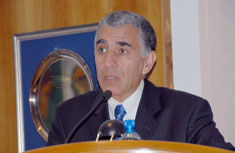
The Study Period commenced with a lecture on “The Maghreb” given by one of the College’s most frequent and valued visitors, Professor Mustapha BENCHENANE, of the Université René Descartes in Paris. The Professor outlined the key characteristics of this region, and the challenges it faces as it goes through an important “transition phase”, and discussed the possible contribution in the region of international organisations including NATO.
The second topic in this Study Period, “the Caucasus”, was addressed by Mr Vladimir SOCOR of the Jamestown Foundation, Washington. His lecture focused particularly on Western interests in the region, especially those related to energy security, threats to the region’s security, and the challenge of providing an appropriate external security framework for the South Caucasus, particularly in the light of the Russia-Georgia conflict.
The next topic on the curriculum was “Russia, Ukraine, Moldova & Belarus” covered in two lectures by Dr Arkady MOSHES, of the Finnish Institute of International Affairs. Dr Moshes expertly analysed the domestic political, social and economic context in these countries, the complex relations between them, and their wider foreign policy orientations, with of course particular attention to relations between Russia and the West and what needed to be done to improve these.
On this day also, whilst not formally part of this Study Period, the Course Members were privileged also to receive a presentation, via VTC from Kabul, by Lieutenant General Jim DUTTON, Deputy Commander of ISAF. Lieutenant General Dutton outlined the current security situation in Afghanistan, highlighting positive achievements to date, discussing current challenges and priorities, and analysing prospects for the future direction of the ISAF mission.
In what has been a particularly full and interesting week, the next day saw first of all the visit of the NATO Secretary General, His Excellency Mr Jaap DE HOOP SCHEFFER. (For more information on this, please see the separate article on this site.)
The regular Study Period programme then resumed with a lecture on “the Western Balkans” given by Ambassador Istvan GYARMATI, Director of the International Centre for Democratic Transition. In a wide-ranging lecture, Ambassador Gyarmati addressed in particular the challenges of finding lasting solutions in Bosnia-Herzegovina and Kosovo, as well as the future prospects for other states in the region, especially with regard to their hopes for integration into Euro-Atlantic structures.
The first part of the Study Period came to an end with a panel of lectures on “Sub-Saharan Africa”, delivered by Mr Tom PORTEOUS, UK Director of Human Rights Watch, and Dr Greg MILLS, Director of the Brenthurst Foundation in Johannesburg. These lectures discussed the key political, social and economic challenges facing the region, especially in the light of the current global economic downturn, the links between these factors and conflict and insecurity, and possible ways of addressing these challenges, including through international engagement.
Prepared by Gavin Kitchingham (GBR C), Chief Curriculum Planning Branch

 NATO Defense College