
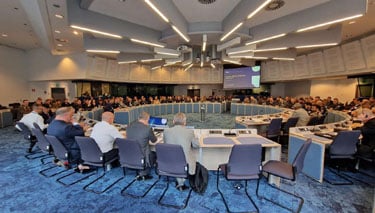
On 27 September 2023, the delegation led by NDC Commandant LGEN Max A.L.T. Nielsen paid a visit to the European Union Military Staff (EUMS) and the European External Action Service (EEAS). At the Charlemagne building, Course Members were given the great opportunity to enjoy in-depth briefings and discussions on EU-related matters and cooperation projects with NATO.
The first presentation of the day was on “The role of the European Union in crisis management, within and beyond its borders, including the assistance to Ukraine”, led by Ms Aleška Simkic, Head of Cabinet of Commissioner for Crisis Management Janez Lenarcic. She began by providing an overview of the Union Civil Protection Mechanism (UCPM), aimed at improving prevention, preparedness, and the response should a disaster occur, not only within EU borders but also further afield. Thanks to strengthened cooperation between EU countries and 9 participating states on civil protection, when an emergency overwhelms the response capabilities of a country, that country can request assistance through the Mechanism, which is able to coordinate the disaster response worldwide, also contributing financially by covering costs for transport and deployments. The briefer explained how the number of operations increased between 2020 and 2023, with the COVID-19 pandemic and the Russian aggression against Ukraine in 2022. In 2023, UCPM registered a significant number of extreme weather events, such as fires in Greece, an earthquake in Türkiye and floods in Slovenia, for which the Mechanism was activated. Before opening the Q&A session, the briefer focused on the importance of enhancing the response capacity of UCPM, including by strengthening synergies and cooperation with NATO through the EU-NATO structured dialogue on resilience. A specifically created task force had released 14 recommendations on critical infrastructure and the EU and NATO were working together on a common matrix for implementation. Questions asked by Course Members mainly focused on how UCPM works in practice, contingency plans in the event of energy shortages, the EU presence in Africa and assistance cooperation with countries that are not part of the EU.
The briefing was followed by a panel discussion on “EU-NATO relations and cooperation and EU support for Ukraine”, with Major General Gábor Horváth, EUMS Deputy Director General and Chief of Staff; Captain Hans Huygens, Head of Current Engagements at the EUMS; Mr Panagiotis Giannakoulias, Head of Sector for Relations with NATO and partner countries, Peace Security and Defence Partnerships, EEAS; Mr Etienne de Durand, Head of the Chief Executive’s Policy Office, European Defence Agency (EDA); and Dr Jan Joel Andersson, Senior Analyst – Security & Defence, European Union Institute for Security Studies (EUISS), with a focus on the Common Security and Defence Policy (CSDP), capability development, the defence industry as well as technology and innovation issues. The panel started with a welcome address by MGEN Horváth, who also gave a short assessment of the situation in Ukraine, after which panellists started introducing topics for discussion along with the EU’s partnerships and cooperation programmes in the defence field, differences between NATO and the EU, and capability development plans in support of Ukraine. Course Members provided substantive contributions through their questions, which led to discussions on cooperation in STRATCOM and the exchange of products to counter disinformation; cooperation in Africa; the Rapid Deployment Capacity; EU involvement in the NATO defence planning process; different approaches to China and many other topics.
At the end of the discussion, the NDC’s Dean, Dr Christopher M. Schnaubelt, gave his closing remarks, thanking panellists for their insights, which had significantly enhanced Course Members’ understanding of the topics addressed.
NDC Public Affairs Office
 NATO Defense College