
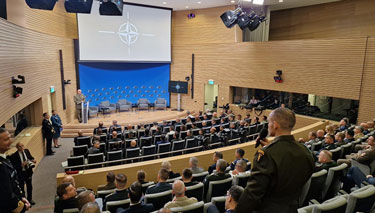
On 25 and 26 September 2023, both Courses visited NATO HQ and SHAPE, a two-day visit where Course Members gained a thorough understanding of NATO’s perspective on political and military consultation processes and key security policy issues.
On arrival, the NDC delegation, led by the NATO Defense College Commandant, Lieutenant General Max A.L.T. Nielsen, was welcomed by the Director General of the NATO International Military Staff (DGIMS), Lieutenant General Janusz Adamczak.
In his keynote speech, Lieutenant General Adamczak stated that “the key to NATO’s success remains the same: it is friendship, solidarity, and an immense ability to unite and adapt to new circumstances. The NATO Defense College superbly embodies all of that.” He went on to explain that “the Alliance is amidst the greatest and largest transformation and adaptation of our collective defence. We have been enhancing our ability to defend all Allies on land, at sea, in the air, in cyber space, and in space.”
Before concluding, the DGIMS also addressed a few questions from Course Members in the audience, notably on NATO’s deterrence and defence posture and on NATO in the context of Russia’s war against Ukraine.
A panel discussion on “NATO’s Current Agenda: Defence and Deterrence of the Alliance post-Vilnius Summit” followed, introduced by Major General François-Marie Gougeon, IMS Director, Policy and Capabilities Division. Speakers included Ms Wendy Gilmour, Assistant Secretary General, Defence Investment Division; Mr Angus Lapsley, Assistant Secretary General, Defence Policy and Planning Division, Ms Caroline Deaves, Defence Counsellor to the Military Representative of the United Kingdom and Lieutenant General Sir Ben Bathurst, Military Representative of the United Kingdom. The lively discussion covered a wide range of topics, with a specific focus on NATO’s support to Ukraine; the new NATO Force Model; cyber defence; NATO’s deterrence and defence posture; and technology innovation and integration into NATO’s future capabilities. “Enablement will be a challenge for the future which will affect NATO’s credibility in technology innovation capability”, a panellist concluded. At the end of the presentation, there was a stimulating Q&A period, during which SC 143 and NRCC 30 Course Members sought to learn more on cooperation among Mediterranean countries; NATO’s support to Ukraine; the deterrence posture after the end of the war; innovation and new technology, from the procurement point of view; the strategic importance of the High North for Euro-Atlantic security, as the gateway to the North Atlantic for the Alliance; and China as a “systemic challenge”.
The academic session then continued with further briefings on “NATO Cooperative Security and Military Cooperation”, delivered by Ms Leila Schilthuis, Partnership West, Political Affairs and Security Policy Division.
After the lunch break, Course Members had the opportunity to meet with their respective national delegations. This brought to closure the visit to NATO HQ in Brussels.
The following day, the NDC delegation was hosted by Supreme Headquarters Allied Powers Europe (SHAPE), where Admiral Joachim Rühle (GER N), Chief of Staff, welcomed Course Members and shared some insights about the war in Ukraine and the readiness of NATO forces. Answering Course Members’ questions, he provided more details on the reinforcement of forces; integrating the command and control structure; integrating partnership into the scenario when countering Russia; and nuclear deterrence.
Rear Admiral Gunnstein Bruåsdal (NOR N), Deputy Chief of Staff, Partnerships Directorate in SHAPE, started his presentation by highlighting the importance of partnership and the contribution it can make to the three NATO core tasks: collective defence, crisis management and cooperative security: He also recalled NATO’s open-door policy, as enshrined in Article 10 of the Washington Treaty. RADM Bruåsdal then gave some insights on ITPPs (Individually Tailored Partnership Programmes) and activities specifically organized for nations with such programmes, in terms of visits, conferences, workshops, etc. “To facilitate dialogue with NATO, each partner country has its representative office in SHAPE”, concluded the briefer.
During the Q&A period, Course Members enquired about cooperation with the United Nations; China and cooperation with countries in Central Asia; and ITPP versus Partnership for Peace (PfP), Mediterranean Dialogue (MD) and Istanbul Cooperation Initiative (ICI).
The following briefing was on “Implementing the DDA (Deterrence and Defence) via the NATO CT&E (Collective Training & Education) Programme”, delivered by Major General Davide Re (ITA F), Deputy Chief of Staff, Plans, and Ancien of Senior Course 114. As MGEN Re indicated, the DDA task gained a renewed focus after Russia’s aggression against Ukraine, and NATO must be able to adapt to the new challenges in implementing DDA according to the new Force Model in terms of command and control, vigilance activities and deployable forces, for a better and effective reaction in case of attack. Training plans are now focusing more on multi-domain exercises in order to optimize deterrence effects. The presentation was followed by several questions from Course Members on the new Force Model, terrorist attacks and changes in posture made by NATO in response to Russian aggression against Georgia, Crimea and other parts of Ukraine.
The last presentation of the day was delivered by Brigadier Charles Grist (GBR A), Assistant Chief of Staff (ACOS), Operations (J3), on “SHAPE Roles and Responsibilities, SWHQ and Current Operations”. Speaking about SWHQ (Static War Headquarters) functions, the briefer underlined their importance in enabling SACEUR to provide policymakers with military advice; to translate political guidance into strategic military objectives; to assess outcomes in order to adjust efforts; and to validate and certify force readiness. Regarding SHAPE’s missions/operations/activities, ACOS J3 gave an overview of current developments, focusing on major efforts to reinforce the eastern flank. The Q&A session touched on several very interesting topics, including NATO’s adaptation to new challenges; NATO air defence support to Türkiye; Finland and the possible reinforcement of the eastern flank from the North; the warfighting HQ and the command and control capability.
In the afternoon, Course Members and Faculty staff interacted with their respective National Military Representative (NMR) offices and Partner National Military Representative (PNMR) offices. This concluded the NATO portion of the Field Study for SC 143 and NRCC 30.
NDC Public Affairs Office
 NATO Defense College